

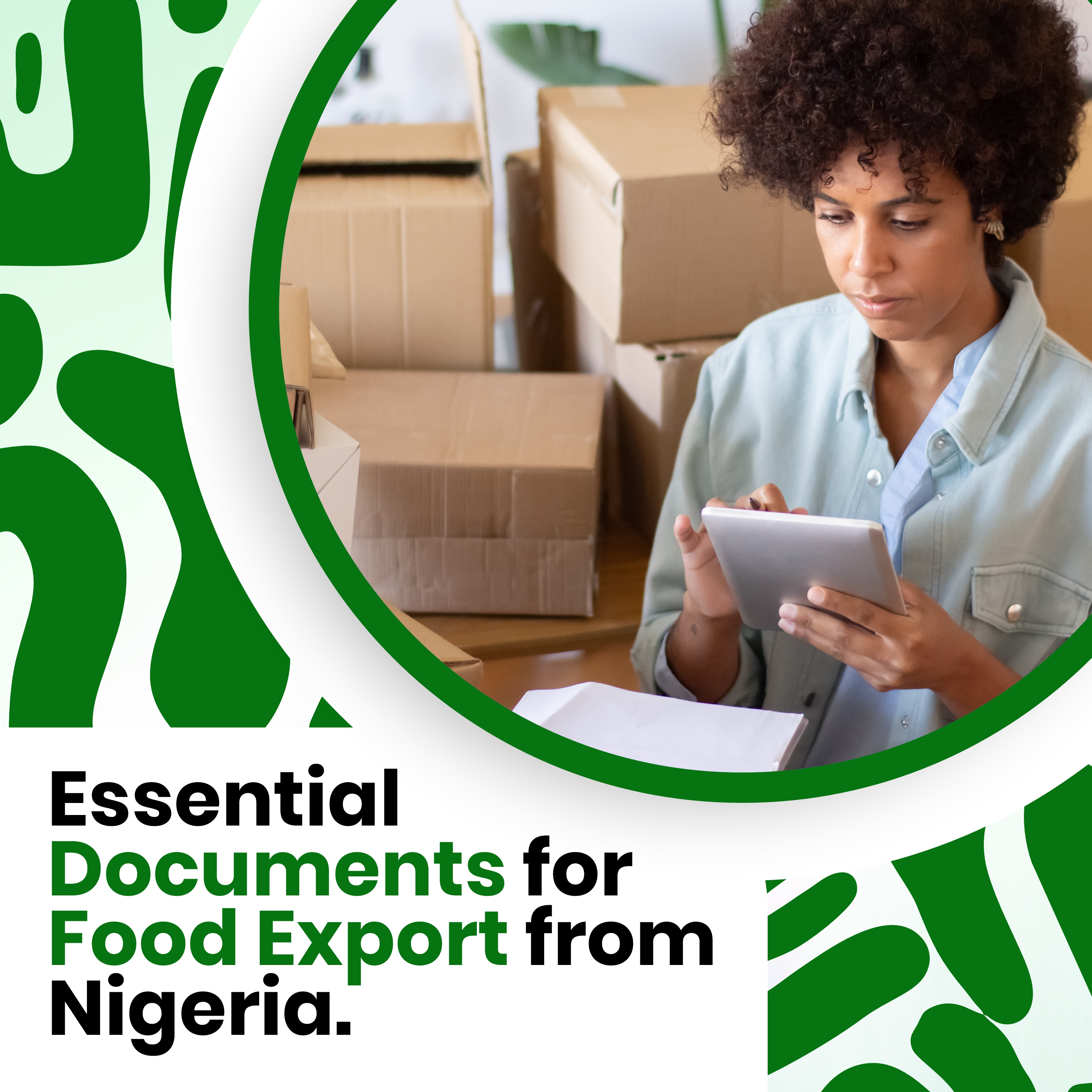
So, You Want to Export Food from Nigeria? Let’s Talk!
Have you ever had a friend beg you to send them Nigerian suya spice all the way from Nigeria to Canada, as if their survival depended on it?

Or maybe an Aunt in the UK who won’t stop reminding you how much she misses homemade chin-chin?

If you’ve ever tried to send food abroad, you already know the struggle is real. It’s not just about packaging it nicely and handing it over to your shipping service provider. No, my dear, there are paperworks involved, plenty of it! So if you’re planning to turn your food export into a full-blown business, prepare to cross your T’s and dot your I’s. Both Nigerian and international regulations are strict.
But fear not! I’m here to walk you through the 5 essential documents for food export from Nigeria to the international market. No long talk, just the real, useful info you need.
5 Essential Documents for Food Export from Nigeria
1. Corporate Affairs Commission (CAC) Registration – Your Business Must Exist First!
Before anything, you need to make your business official. That means registering it with the Corporate Affairs Commission (CAC). Think of it like getting your birth certificate before you can apply for a passport. Without this, you’re just a person sending random foodstuff abroad, not a bonafide exporter.
Why You Need It:
- It gives your business legal backing.
- Banks won’t open a corporate account for you without it.
- Export agencies and customs officials take you more seriously when your business is properly registered.
How to Get It:
- Visit the CAC portal (get started here)
- Choose a unique business name.
- Register as a Business Name (if you’re a small startup) or a Limited Liability Company (LLC) (for bigger operations).
- Send all the required documents and pay the registration fee.
Pro Tip: Get an expert to help you out if you don’t want unnecessary delays!
2. NAFDAC Registration
If you’re exporting processed or packaged food, you need approval from the National Agency for Food and Drug Administration and Control (NAFDAC). You must obtain approval from NAFDAC. NAFDAC doesn’t care if your grandma’s groundnut oil is the best in Lagos. If it’s not approved, it’s not leaving the country legally!
Why You Need It:
- It shows your food is safe for consumption.
- Many international markets won’t allow Nigerian food imports without this certification.
- Avoid customs wahala (trust me, you don’t want that drama!).
How to Get It:
- Send your product for inspection and testing.
- Give proof of business registration.
- Meet packaging and labeling requirements.
- Pay the necessary fees.
Pro Tip: Don’t cut corners. If NAFDAC seizes your shipment, you’ll regret it quickly. It will be faster than a Lagos danfo driver speeds off after collecting your change (very daunting).
3. Export Promotion Council (NEPC) Registration
The Nigerian Export Promotion Council (NEPC) is basically your permission slip to export legally. Without it, your goods will be treated as contraband, and that’s the last thing you need.
Why You Need It:
- It proves you’re a legitimate exporter.
- Some international markets ask for it as part of their import requirements.
- It helps with accessing export incentives from the government (yes, free money if you play your cards right!).
How to Get It:
- Register on the NEPC website.
- Give business registration and NAFDAC details.
- Pay the registration fee.
Pro Tip: NEPC also offers training on how to scale your export business, so make use of their resources!
4. FDA Registration (For U.S. Export)
If you’re exporting to the United States, you’ll need U.S. Food and Drug Administration (FDA) registration. This is the American version of NAFDAC but on steroids, because once you mess up, there’s no coming back!
Why You Need It:
- It’s mandatory for exporting food to the U.S.
- It ensures compliance with U.S. food safety laws.
- If you don’t have it, your goods can be seized and destroyed at U.S. customs (yes, they will throw away your precious jollof rice mix like it’s trash!).
How to Get It:
- Register your business with the FDA.
- Appoint a U.S. agent (someone based in the U.S. who will act as your contact person).
- Send your food facility details.
- Renew annually (don’t forget this part, or you’re back to square one!).
Pro Tip: Work with an FDA expert consultant (like African Import Export Services) to make your life easier.
5. Customs Export Clearance (Nigeria Customs Service)
Ah, the final document: Nigeria Customs Service (NCS)! If you’ve survived all the earlier steps, you still need export clearance from customs before your goods can leave Nigeria.
Why You Need It:
- It ensures your shipment is documented and duty-compliant.
- It prevents your goods from being seized at the port.
- It helps with export duty refunds where applicable.
How to Get It:
- Give all the documents listed above (CAC, NAFDAC, NEPC, etc.).
- Send a proforma invoice and bill of lading.
- Pay any required export duties.
- Get clearance from customs officers.
Now, instead of sweating at the airport over dealing with customs, paperwork, you can confidently send your chin chin, crayfish, or palm oil overseas without stress, and the trouble of sorting out your export documents because that’s where African Import Export Services comes in!

We help businesses like yours handle the paperwork, so you can focus on exporting your items abroad, making money, and satisfying your customers/clients worldwide.
Ready to take the first step? Let’s make your food export dreams come true: stress-free!
FAQs
1. How long does it take to get NAFDAC approval?
It depends on your product type, but expect anywhere from 3 to 6 months.
2. Can I export homemade food items without registration?
For personal use, maybe. But for commercial export, NO, you must be registered.
3. What are the key export documents required to export food from Nigeria?
The essential export documents include CAC registration, NAFDAC approval, NEPC registration, FDA registration (for the U.S.), and Nigeria Customs clearance.
4. Do I need all these documents if I’m only exporting within Africa?
Some African countries need less documentation, but having these makes life easier.
5. How much does FDA registration cost?
It varies, but expect to spend at least $200-$500 annually
6. Can I handle export documents myself?
You can, but it’s better to work with experts (like African Import Export Services) to avoid costly mistakes!
7. Can I export food without NAFDAC registration?
No, NAFDAC approval is mandatory for processed and packaged food exports.
8. How long does NEPC registration take?
It typically takes 1-3 weeks depending on processing times.
9. Is FDA registration compulsory for all food exports?
Only if you’re exporting to the United States. Other countries have their own food safety regulations.
10. How do I avoid Nigerian Customs delays?
Make sure all documents are complete, duties are paid, and work with a licensed customs agent.


Leave a Reply