

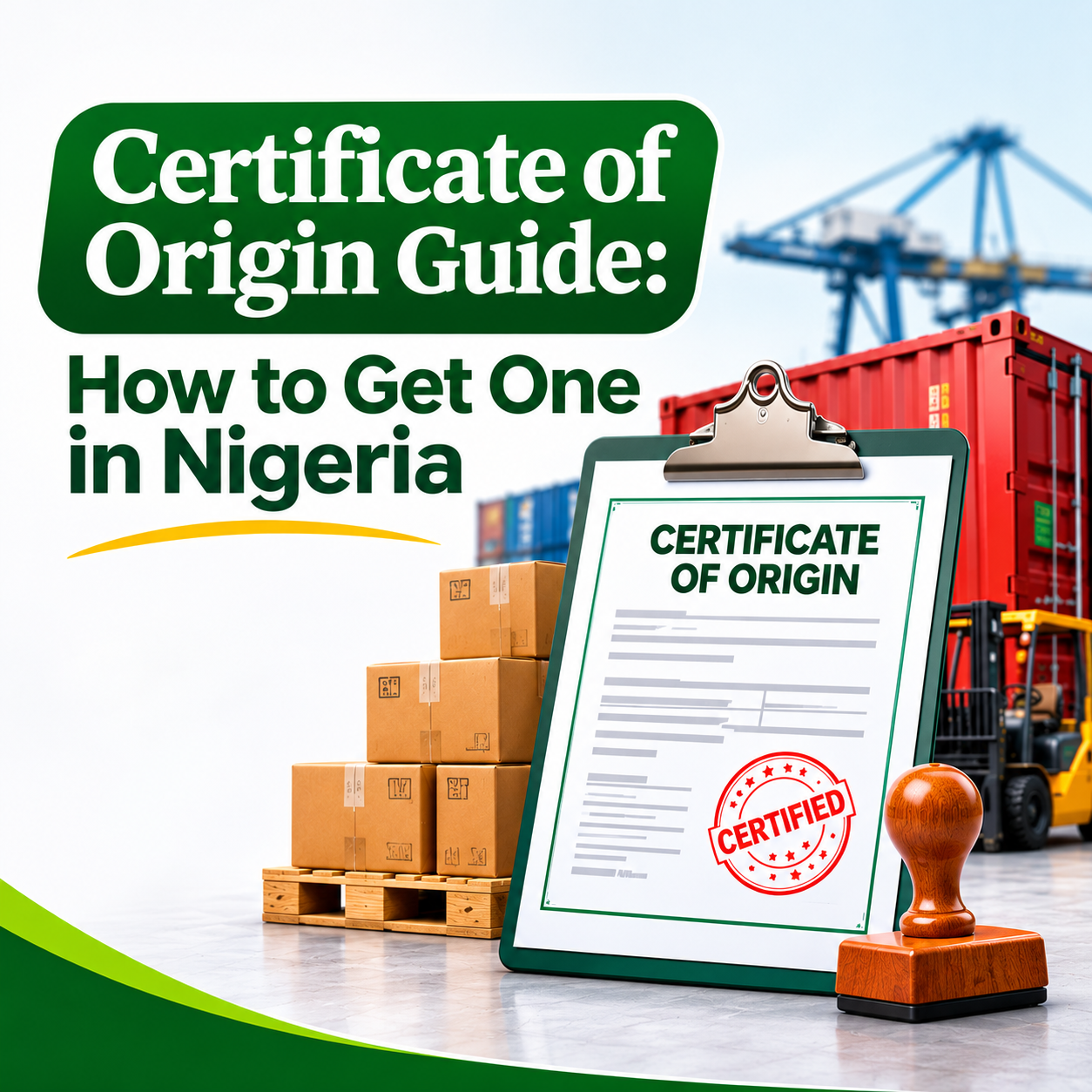

Your buyer has confirmed the order, the goods are nearly packed, and someone asks for a certificate of origin. You’ve got an invoice and evidence that you bought the goods in Nigeria. But does that prove Nigerian origin, and should you apply through NACCIMA, Nigeria Customs Service, or an ECOWAS process?
For Nigerian food processors, fashion brands and manufacturers, the wrong choice can leave an otherwise organised shipment waiting for corrected paperwork. The practical starting point isn’t the form. It’s the destination, the tariff treatment you’re claiming, and the records that prove how the goods were produced.
Table of Contents
- Which Certificate of Origin Applies to Your Shipment
- Documents You Need Before You Apply
- How to Get a Certificate of Origin Step by Step
- How Long Applications Take and Where They Stall
- Using the Certificate for Preferential Tariffs and Customs Clearance
- Confirm Your Destination Rules Before You File
Which Certificate of Origin Applies to Your Shipment
A certificate of origin confirms where goods were manufactured, produced, processed or obtained. Customs uses that information when assessing origin and eligibility for tariff treatment. The Nigeria Trade Information Portal identifies NACCIMA, the National Association of Chambers of Commerce, Industry, Mines and Agriculture, as the issuing body for the conventional Nigerian export certificate.
Country of shipment isn’t necessarily country of origin. Buying imported goods in Lagos and sending them abroad doesn’t automatically make them Nigerian.
Understand the origin test first
A product is wholly obtained when it is grown, mined or produced entirely in Nigeria under the applicable rule. A product containing imported inputs may qualify as sufficiently worked or processed if Nigerian production satisfies the product-specific requirement for its Harmonized System, or HS, code.
The official AfCFTA application guide explains the need to check the product-specific rule and support claims involving imported inputs, including relevant value-added, tariff-classification, or processing requirements. Confirm the exact test before choosing the certificate route.
Certificate of origin by shipment case
| Shipment case | Who issues the certificate | What it is used for |
|---|---|---|
| Ordinary export, no trade-agreement claim | NACCIMA, as identified by NEPC | Proof that goods originate in Nigeria |
| AfCFTA preferential shipment | Nigeria Customs Service through the AfCFTA portal | Tariff preference under AfCFTA rules |
| Trade within ECOWAS under the ETLS | NACCIMA application route in Nigeria’s ETLS export guide; confirm the designated issuing office on Nigeria’s trade portal | Duty-free treatment when ETLS rules are met |
| Food, drug or manufactured goods | NACCIMA, after product registration with the relevant agency, for the ordinary certificate route | Origin proof alongside product approval |
| Exporter registration | NEPC e-registration platform, which issues the Exporter’s Certificate | Not an origin certificate and does not replace one |

Match the route to the transaction
Say a Lagos fashion brand is sending garments to Accra. If the buyer only needs ordinary origin evidence, that’s a different request from an ETLS preference claim, which requires the appropriate product eligibility and approval process.
A Kano food processor shipping to Cotonou must also address the food product’s regulatory position. An origin certificate doesn’t replace the relevant product registration or certification.
Practical rule: The Exporter’s Certificate establishes your registration as an exporter. It doesn’t establish the origin of a particular consignment.
Choose the matching shipment case before touching an application. When planning air cargo exports from Nigeria, settle the certificate route before committing the paperwork to a departure schedule.
Documents You Need Before You Apply
Documents for a certificate of origin application
| Document | What it proves | When it is needed |
|---|---|---|
| Commercial invoice | Price, seller and buyer details | Every origin application |
| Packing list | Quantity and package marks | Every origin application |
| Bill of lading or airway bill | Transport route and shipment details | Every origin application, using the transport evidence accepted at filing |
| Supplier declarations | Origin of purchased inputs | AfCFTA claims using bought-in materials |
| Purchase invoices and proof of payment | Value of imported inputs | Where value-added rules apply |
| Production process description | How the goods were made or processed | Manufactured and processed goods |
| Form NXP | Records the export transaction within Nigeria’s wider export documentation process | Confirm its role with NEPC before filing |
Treat these as a working evidence file, not attachments to collect after submission. Nigeria’s trade portal guidance distinguishes the wider export documentation file from the supporting evidence needed for preferential origin claims.
The commercial invoice, packing list and transport document establish the transaction and shipment. The reviewer should be able to connect the goods sold, the packages prepared and the cargo being transported without guessing. If a final transport document isn’t available at application, confirm which booking or shipment details the issuer accepts.
Add evidence for the production claim
Supplier declarations matter when your claim relies on purchased materials. They should identify the materials clearly enough to connect them to your purchasing and production records, rather than state that the supplier is Nigerian.
For imported inputs, retain purchase invoices and proof of payment where the applicable rule requires value calculations. For manufactured or processed goods, describe the actual operations: what enters production, what changes, and what finished product leaves the factory.
Product-quality evidence serves a different purpose. For example, businesses assessing hemp ingredients can explore hemp ingredient certifications from Allive to understand supplier-quality documentation, without treating those certifications as a substitute for Nigerian origin evidence.
A supplier’s quality certificate may support a purchasing decision. It doesn’t, by itself, prove that your finished product meets a trade agreement’s origin rule.
Keep the wider export file organised
Common documents for shipping from Nigeria include an invoice, packing list, sender and receiver details, plus export permits or product certificates where needed. Use an export document checklist to organise that wider file, and confirm Form NXP’s role with NEPC before filing.
Keep a separate folder for each shipment, with clearly labelled final versions and supporting records. Don’t reuse an invoice number or copy a previous order’s description without checking the actual goods, buyer and shipment details.
How to Get a Certificate of Origin Step by Step
The Nigerian government’s ETLS export guide.pdf) connects the NACCIMA application with enterprise details, transaction information and applicable product registrations. It identifies SON-MANCAP, NAFDAC and Nigerian Agricultural Quarantine Service requirements for relevant product categories, so certificate preparation must fit around the product’s compliance work.

Establish eligibility before filing
-
Confirm the destination and product rule. Start with the finished product’s correct HS code, then check the origin requirement for the destination and agreement you intend to use. A common slip is copying a supplier’s input code onto a finished product without checking whether the classification still fits.
-
Complete exporter registration. Register through NEPC’s e-registration platform if you haven’t already done so, and retain the Exporter’s Certificate in your business records. Don’t submit that registration document as though it certifies the origin of the goods.
-
Secure the applicable product approvals. Manufactured goods may require SON-MANCAP, food and drugs may require NAFDAC registration or certification, and agricultural products may require NAQS certification. Establish which approvals apply and complete the necessary stages before submitting a file that relies on them, rather than assuming the origin application resolves product compliance.
-
Complete the correct application. Enter the enterprise and transaction details on the NACCIMA application for the relevant conventional route, or use the Customs application for an AfCFTA claim. Don’t choose a form just because it was accepted for another customer or destination.
Assemble and reconcile the shipment file
-
Build the evidence pack. Include the application, invoice, packing list, transport or export declaration details, applicable product approvals and records supporting Nigerian manufacture or processing. A frequent weakness is submitting finished-goods invoices without the input or production records needed to explain the origin claim.
-
Cross-check every shared field. Reconcile the legal exporter name, consignee, goods description, HS code, quantity, invoice value, package marks and transport details across the file. This is the easiest stage to rush, especially when sales, production and logistics staff have prepared different documents.
Before submission: Ask someone other than the document preparer to compare the application against the final invoice and packing list, field by field.
-
Submit, pay the applicable fee and respond to queries. Use the designated submission channel, confirm the current charge with the issuing authority, and keep the acknowledgement and payment record together. If the reviewer requests production evidence or an inspection, answer the specific request rather than uploading the same incomplete pack again.
-
Collect and inspect the issued certificate. Compare the issued document with the approved shipment file before cargo handover, including consignee details and package references. Don’t assume an issued certificate is error-free, and don’t alter it yourself if you find a mistake.
Keep responsibility clear throughout: one person should control the final document versions, even if several staff members contribute information. For a coordinated handover, use a documentation preparation checklist alongside the issuing authority’s requirements, not instead of them.
How Long Applications Take and Where They Stall
The historical benchmark is a maximum processing time of 48 hours from receipt of an application, stated in the Nigeria import-documentation guidance describing the Central Bank of Nigeria’s April 2017 replacement of the Combined Certificate of Value and Origin with a simpler Certificate of Origin.
That’s an import-documentation benchmark, not a universal turnaround promise for NACCIMA, ETLS or AfCFTA export applications. Confirm the current service standard with the issuing body before using it in a shipping plan.
Separate issuance from preparation
The application review is only part of the schedule. Plan around these distinct activities:
- Product approvals: Establish the current SON-MANCAP, NAFDAC or NAQS requirements for your goods and obtain the relevant agency’s timeline.
- Verification queries: Allow room to explain an HS classification, an input invoice or a discrepancy in consignee details.
- Inspections: Confirm whether the product or preference route requires a facility or goods inspection before approval.
- Corrections: Leave time for the issuer to review amendments if an error is found after submission.
A portal submission receipt doesn’t mean the evidence has passed review. Equally, paying a fee doesn’t resolve an incomplete production declaration.
Work backwards from cargo handover, allowing for outstanding approvals, the issuer’s confirmed review window and a buffer for questions.
Check the avoidable hold-ups
Before submission, inspect product-registration validity, declaration signatures and the buyer’s final legal name. If the buyer changes after the invoice is issued, update the affected documents together rather than changing only the application.
Avoid making a non-flexible cargo commitment while essential approvals remain unresolved. A cheaper booking can become poor value if the paperwork won’t be ready for handover.
Using the Certificate for Preferential Tariffs and Customs Clearance
A qualifying origin certificate can support reduced or zero tariff treatment, but the benefit comes from meeting the agreement’s rules, not merely possessing a stamped document. The NEPC export-document guide identifies origin evidence as part of export documentation supporting trade-agreement treatment; under ETLS, eligibility also requires the applicable origin and product-registration conditions.
For AfCFTA exports, the Nigeria Customs Service is the issuing authority, with applications submitted through its AfCFTA certificate-of-origin portal. Customs reviews the product classification, applicable origin rule, and supporting evidence before issuing the certificate.

Present a defensible clearance file
International shipments usually require a customs declaration showing contents, quantity, value and purpose. Present the origin certificate alongside that declaration and the other required clearance documents, rather than expecting it to replace them.
Consider a manufacturer that imports finished parts and merely repackages them in Nigeria. That activity may not satisfy the applicable origin rule, while a producer carrying out qualifying local manufacturing can support its claim with production records, input invoices and a process description.
Local manufacture still needs to meet the actual product rule. Keep the recorded origin basis and supporting records for the period required by the relevant authority, and confirm that retention requirement rather than borrowing one from another trade agreement.
Check before cargo handover
- Document agreement: Shared shipment fields reconcile line by line.
- Valid approvals: Relevant product registrations remain valid for the shipment.
- Recorded origin basis: The claimed criterion is supported by production and input evidence.
- Correct values: Invoice and declared values are accurate and explainable.
- Matching consignee: The certificate identifies the intended recipient correctly.
Don’t carry an African preference assumption into an unrelated destination. Businesses arranging ocean exports from Nigeria to the USA must establish the US destination requirements separately.
Confirm Your Destination Rules Before You File
Use this pre-filing sequence to decide whether your shipment is ready for submission:
- Confirm the destination and applicable product rule. Resolve classification questions before committing to an origin claim.
- Check registration status. Make sure exporter registration and required product approvals are current.
- Choose the certificate route. Match the transaction to ordinary origin evidence, AfCFTA preference or ETLS treatment.
- Approve the evidence pack. Reconcile names, HS codes, quantities and values, and remove superseded drafts.
- Release the cargo booking when ready. Leave room for the authority’s review and any outstanding verification.
The useful next conversation is with someone who can identify the missing evidence, rather than find another blank form. For businesses preparing to export from Nigeria to the USA, that includes separating origin paperwork from destination-specific compliance.
Get preparation support without confusing the issuer
Our Export Licenses & Documentation service registers export businesses and obtains required licences and documentation; our team can review the shipment file, prepare the surrounding paperwork and help sequence approvals and filings. African Import Export Solution also offers FDA & Export Documentation, Training & Development, and customs clearance support for most major export destinations, either directly or through local brokers.
The designated authority issues the certificate of origin. Our role is preparation and filing support, not replacing NACCIMA or Nigeria Customs Service.
Keep the evidence file ready for review before you submit it. That gives everyone a clear basis for resolving gaps before the application reaches the issuing body.
African Import Export Solution offers export documentation and customs clearance support to help you prepare a consistent shipment file around your certificate of origin. Visit African Import Export Solution and send your product description, destination, draft invoice, packing list and available production records for review before filing.

Leave a Reply