

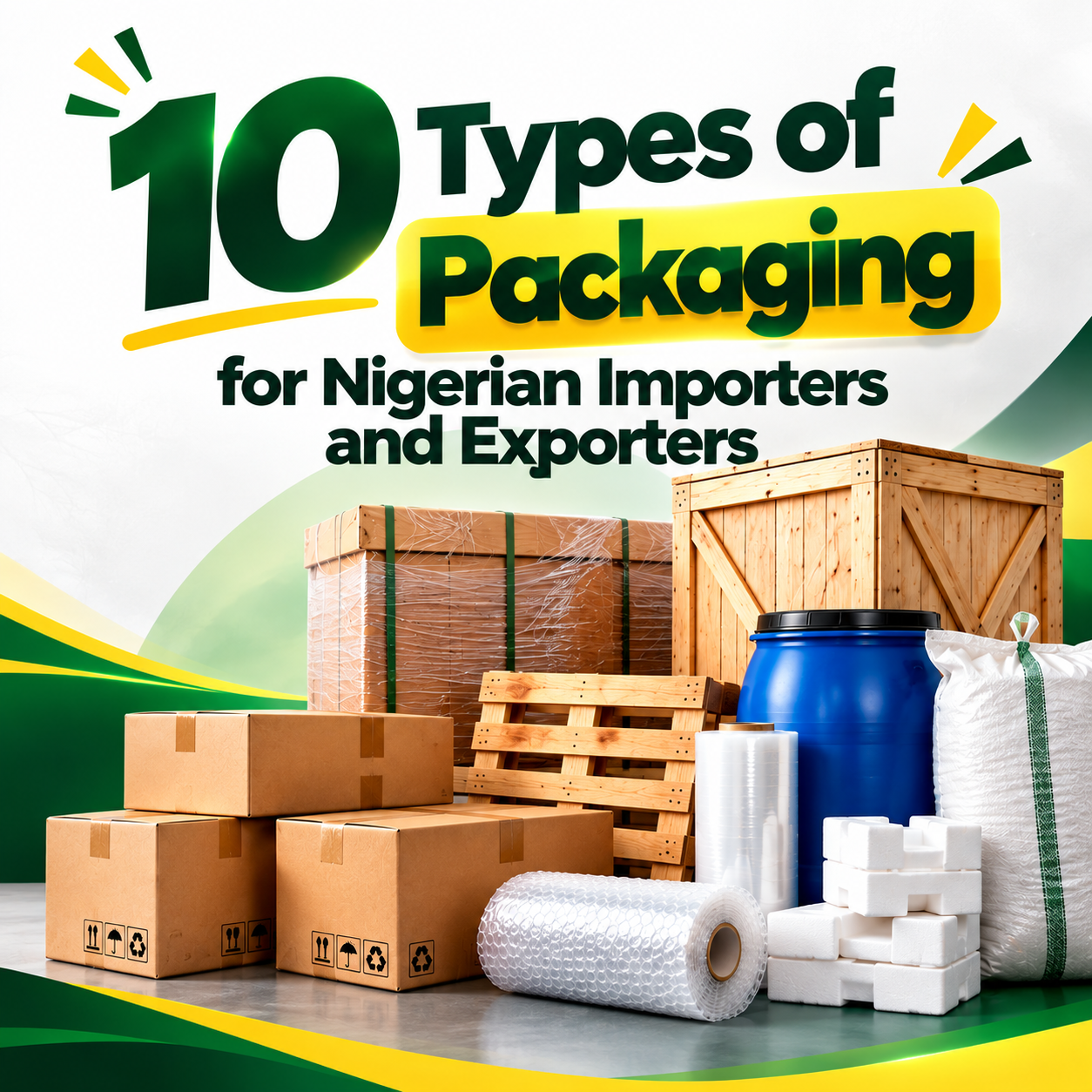

If you import or export goods in Nigeria, packaging is not just about making your products look good.
It can determine whether your goods arrive safely, whether you pay unnecessary shipping costs, and whether your products are still sellable when they reach their destination.
Imagine importing 500 units of a product from China at a great price. You negotiated well, found a reliable supplier, and arranged shipping to Nigeria.
But when the shipment arrives, several cartons are crushed, some products are damaged by moisture, and the boxes are so oversized that you paid more freight than necessary.
Suddenly, the “good deal” does not look so good anymore.
The same problem can happen when exporting products from Nigeria. Agricultural products can be exposed to moisture, glass bottles can break, cartons can collapse during handling, and poorly sealed products may become contaminated before reaching the buyer.
That is why smart importers and exporters should think about packaging before their goods leave the supplier, factory, warehouse, or production facility.
The right packaging should do three things well:
Protect the product. Reduce unnecessary logistics costs. Make handling and transportation easier.
But different products require different packaging.
A shipment of electronics should not necessarily be packaged the same way as agricultural produce. Machinery needs different protection than clothing, while fragile products such as glassware need much more cushioning than footwear.
In this guide, we will explain 10 types of packaging Nigerian importers and exporters should know, when each type is appropriate, and what to consider before choosing packaging for your next shipment. Landed cost.
Table of Contents
- 1. Corrugated Cardboard Boxes
- 2. Rigid Boxes and Telescoping Boxes
- 3. Poly Mailers and Padded Envelopes
- 4. Vacuum-Sealed and Compressed Packaging
- 5. Reusable and Foldable Containers
- 6. Biodegradable and Compostable Packaging
- 7. Foam and Bubble Cushioning Systems
- 8. Moisture Barriers and Desiccant Packaging
- 9. Custom-Printed and Branded Packaging
- 10. Heavy-Duty Pallets and Crating
- Comparison of 10 Packaging Types
- Choosing Packaging That Fits Your Route and Budget
10 Types of Packaging for Nigerian Importers and Exporters
1. Corrugated Cardboard Boxes
Corrugated cardboard cartons are among the most common forms of packaging used in international trade.
They are lightweight, relatively inexpensive, easy to stack, and available in many sizes and strengths.
They are commonly used for:
– Clothing and fashion items
– Shoes
– Electronics
– Beauty products
– Household products
– Toys
– Auto parts
– Small appliances
– Packaged foods
– E-commerce products
However, not every cardboard box provides the same level of protection.
Light products may work well with standard cartons, while heavier products may require double-wall or reinforced corrugated boxes.
Why importers like cardboard cartons
They provide a good balance between protection, weight, cost, and ease of handling.
They can also be labelled easily with product information, handling instructions, barcodes, shipment references, and other identification.
The risk
A weak carton carrying heavy goods may collapse when other cartons are stacked on top of it.
For international shipments, choosing the correct carton strength is therefore just as important as choosing the carton itself.

2. Rigid Boxes and Telescoping Boxes
Rigid boxes are the premium option when the package itself has to signal quality before the buyer opens it. They don’t flex much, they hold their shape, and they make sense for products where presentation is part of the value. Telescoping boxes, with a separate base and lid, are especially useful when you want a neat fit without relying on glue-heavy construction.
Nigerian exporters selling luxury clothing, beauty products, artisanal gifts, or specialty accessories often use rigid packaging for international buyers who expect a more polished finish. The box can become part of the product story, especially for boutiques, gift sets, and limited runs. High-value electronics and accessories imported from China can also benefit, but only when the added packaging cost is justified by the margin.
Where premium packaging earns its keep
Rigid boxes are best reserved for lines with enough margin to absorb the extra cost. If the item is cheap, the box can distort the economics fast. In those cases, a clean corrugated box with a smart print finish often delivers a better trade-off.
A premium box can protect the product and support the brand, but it can also become expensive inventory if the item itself doesn’t carry the margin.
Telescoping formats are useful in packing rooms because they’re easy to assemble and don’t always need glue. Add tissue paper, inserts, or a custom tray only when the customer experience or product stability justifies it. For special editions, gift sets, and flagship SKUs, rigid packaging does the job well. For standard replenishment stock, it often adds cost without enough freight or damage benefit.
3. Poly Mailers and Padded Envelopes
Poly mailers are the right answer when the goods are soft, flat, and not easily crushed. They keep weight down, resist moisture, and travel well in express air shipments. Padded envelopes do the same job but add a cushioning layer for items that need a little more shock resistance.
This is why fashion exporters use them for t-shirts, scarves, and lightweight accessories, especially when shipping direct to customers in the USA. Importers bringing in samples or small components from China also use them because they take up very little space. In parcel-heavy e-commerce, the packaging often matters as much as the product because it determines whether the shipment stays cheap enough to keep margins intact.
If you’re sending goods from the USA into Nigeria, the wrong pack can turn a small parcel into a costly one very quickly. It becomes easier to manage shipping from USA to Nigeria if the product is already packed in a light, tight mailer rather than a bulky carton.
Where they fail
Poly mailers are not for anything rigid, fragile, or likely to be bent beyond tolerance. They also don’t give much brand presence unless you print them properly. That said, for soft goods, they can cut unnecessary freight weight and simplify fulfilment.
protect products from plant to shelf
For direct-to-consumer orders, the package has to survive the lane and still feel clean when the buyer opens it.
Custom-printed mailers can make a low-cost product feel more deliberate, but keep the size tight. Oversized mailers waste space and can erase the savings you hoped to get. For bulk ocean freight, they’re usually more useful inside consolidated cartons than as the outer layer.
4. Vacuum-Sealed and Compressed Packaging
Vacuum sealing is one of the clearest ways to cut freight volume on soft goods. Once the air is removed, textiles, bedding, pillows, and similar products take up far less space. That can make the difference between sending a shipment by air and waiting for ocean transit.
This matters for Nigerian textile exporters, bedding suppliers, and fashion wholesalers who need to move more units in less space. It also helps importers receiving bulk soft goods from China because the compressed format protects inventory density in the container. In real handling terms, less volume usually means fewer cartons, easier pallet build, and lower chance of wasted void space.
Why compression changes the route decision
A compressed product can turn an expensive air shipment into a workable one because the carton becomes smaller and easier to rate. For ocean freight, vacuum sealing helps protect textiles from moisture during long transit and storage. The trade-off is obvious, over-compression can harm the product if staff don’t handle the sealing process correctly.
Use vacuum sealing before boxing, not after the carton is already full. That makes stacking and pallet building cleaner. It also helps staff spot whether the product still has shape and whether it needs a second layer of protection.

A warehouse that ships soft goods regularly should treat vacuum sealing as part of the packing workflow, not an afterthought. If the sealing is poor, the package expands in transit and the savings disappear. If it’s done well, you move more product with less freight pressure.
5. Reusable and Foldable Containers
Reusable containers make sense when the same route repeats often enough to justify return logistics. Foldable boxes, collapsible crates, and return-trip bins reduce waste and can lower long-term packaging spend if they’re used consistently. They’re especially useful in supply chains that move goods between Nigeria, China, and the USA on a regular rhythm.
For a Nigerian importer placing monthly orders from the same supplier, reusable crates can be practical. A fashion wholesaler moving stock from a US distributor can also benefit if the supplier accepts returns cleanly. Food processors and manufacturers that work with predictable replenishment cycles get the most value, because the container doesn’t become stranded after one trip.
When reuse is worth the effort
The container only pays back if you use it again. That means you need route discipline, supplier agreement, and a clear return process. If the shipment is one-off, disposable packaging is usually simpler and cheaper.
Reusable packaging is a supply-chain decision, not just a packing decision.
Measure the full cost, including cleaning, repairs, and any return leg. For ocean freight, the longer transit window can make return planning easier, but only if the origin and destination teams keep track of the units. A freight partner that handles consolidation and returns can make the system workable, especially when several shipments move through the same trade lane.
6. Biodegradable and Compostable Packaging
Biodegradable packaging is often discussed as a brand story, but in export work it has to survive the actual trip. Compostable mailers, kraft alternatives, and PHA-based options can help brands that sell into markets where sustainability matters, especially the USA and EU. The product still has to arrive clean, protected, and legible.
Nigerian fashion exporters, cosmetics brands, and food businesses use these formats when the buyer values environmental positioning. They can be a strong fit for premium orders or retail accounts that ask for documented sustainability claims. The important point is that the packaging has to be suitable for the product, not just visually green.
Sustainability needs proof, not slogans
Check whether the buyer wants compostable packaging before you commit to bulk purchase. Some retailers ask for certifications, and others care more about performance and price. If the pack fails in humid handling conditions, the environmental story won’t save the shipment.
Practical insight: a sustainable package that ruins the product creates more waste than it prevents.
AfricanIES’s waste-focused guidance helps businesses think through material choice and disposal impact. The strongest approach is often hybrid: use sustainable formats where they add brand value, and keep conventional packaging for bulk or rough handling. If you’re going to print disposal instructions, make them simple and clear. Buyers appreciate packaging they can understand without guessing.
Simply Hospitality on disposal systems
7. Foam and Bubble Cushioning Systems
Fragile goods need cushioning, and they need it before the outer box is sealed. Foam inserts, bubble wrap, air pillows, and anti-static materials are there to stop movement, absorb knocks, and prevent pressure damage. Without them, even a strong carton can fail if the contents rattle around.
This is the right choice for glassware, ceramics, electronics, and delicate accessories coming from China or the USA. It also matters for Nigerian exporters sending beaded fashion pieces, decorative items, and premium products that need to survive long handling chains. The cost of cushioning is usually tiny compared with the cost of a damage claim or replacement.
How to decide how much protection is enough
The longer and rougher the route, the more important proper cushioning becomes. Air freight is faster, but it still includes handling, sorting, and terminal movement. Ocean freight adds time, stacking, and more exposure to rough conditions.
Use anti-static foam or bubble wrap for anything with circuitry. For electronics, that detail matters because static damage can be invisible until the item fails later. For fragile exports, custom foam inserts also improve presentation, which helps when the buyer opens the box in a retail setting.
A small packing upgrade can stop a big dispute at destination.
Warehouse teams should be trained to wrap properly, not just quickly. Too little protection does nothing, but too much can add cost without improving safety. The best pack is the one that keeps the item stable without turning the carton into wasted air.
8. Moisture Barriers and Desiccant Packaging
Moisture is one of the most common reasons packaged goods arrive in bad shape. Silica gel packets, desiccant sheets, and moisture-barrier films keep humidity from attacking the product inside the carton. That matters a lot on long ocean routes, especially when goods cross damp ports or sit in storage before delivery.
Importers bringing electronics, leather goods, textiles, or spices from China into Nigeria use desiccants to cut rust, odour, mold, and colour change risk. Exporters moving food or fabric also benefit because humidity can ruin the finished product before the buyer ever sees it. These packs are small, but the effect on salvage rates can be huge.
Moisture control has to match the product
A dry product can still be damaged if the packaging leaks or breathes too much. That is why moisture control should sit alongside sealing, not replace it. Put the desiccant in the carton, seal the box properly, then mark the pack clearly so nobody mistakes it for the product.
For long ocean shipments, moisture protection should be built into the packing spec, not added only when someone remembers.
If the shipment is food, label placement matters even more because desiccant packs shouldn’t be confused with consumables. For higher-risk goods, combine moisture barriers with a tight carton and a strong closure. A supplier in China can often include desiccants at low extra cost if you ask early enough, which is better than discovering the problem after goods arrive wet or stained.
9. Custom-Printed and Branded Packaging
Branded packaging turns the box, pouch, or mailer into part of the sales process. It tells buyers who you are, what the product is, and whether the business looks organised enough for repeat orders. For exporters, that matters because international buyers often judge the product before they ever use it.
Fashion exporters, cosmetics brands, craft sellers, and food businesses all use branding to separate themselves from generic sellers. A clean logo, product information, and consistent colours can make a shipment look more credible. The package also helps in e-commerce because the unboxing experience often becomes part of the customer’s impression of quality.
Branding should support compliance, not hide it
The label still has to do its job. If the branding makes required information hard to read, the package becomes a problem rather than a benefit. That is especially important for food and regulated products where the product name, ingredients, and storage details must stay visible.
Use this product label redesign resource when the goal is to improve both presentation and readability. Don’t overdesign the pack so much that it becomes expensive or hard to reproduce. For many Nigerian SMEs, a simple printed carton or mailer is enough to look professional without overcommitting cash.
The strongest branding works when it’s repeatable. If every shipment looks different, buyers notice. If the pack is consistent and clean, it supports trust.
10. Heavy-Duty Pallets and Crating
Pallets and crates are for heavy, grouped, or awkward cargo that needs stability more than elegance. They make sense when the load is large enough that hand-carrying or loose cartons would create too much handling risk. For ocean freight especially, they help keep multiple cartons together and reduce shifting.
Manufacturers, wholesalers, and importers moving bulk stock from Nigeria, China, or the USA use pallets to make warehouse handling simpler. They’re also useful when shipping to retail partners who expect organised receipt and easy fork access. Crating adds more structure when the goods are fragile, irregular, or too valuable to move loose.
Stability comes first
Use pallets only when the consolidation benefit outweighs the extra material and weight. If the shipment is too small, a pallet just adds cost. If it’s large, unpalletised cargo can create far more damage than the pallet ever costs.
If your shipment can’t stay stable while being moved, it isn’t ready to travel.
For international movement, the pallet should be properly certified and documented, and cargo should be wrapped or strapped so it won’t shift in transit. Stack cartons to use space well, and tell the freight forwarder the pallet dimensions and total weight before booking. If you ship through a warehouse model, US warehousing support can make pallet handling and fulfilment easier to manage on the destination side.
How to Choose the Right Packaging for Your Shipment
There is no single “best packaging” for every shipment.
Before choosing, ask yourself:
What am I shipping?
Start with the nature of the product. Is it fragile, heavy, liquid, perishable, sensitive to moisture, expensive, or unusually shaped?
How is it being shipped?
Air and ocean shipments can have different weight, volume, handling, and environmental considerations.
How valuable is it?
A ₦50,000 shipment and a ₦20 million machine do not necessarily require the same level of protection.
How long will it be in transit?
Longer journeys can increase exposure to handling and environmental conditions.
How will the goods be handled?
Consider loading, unloading, stacking, forklift movement, warehouse storage, and final transportation.
Are there regulatory requirements?
Food, agricultural products, dangerous goods, wooden packaging, and other regulated commodities may have specific packaging requirements.
Comparison of 10 Packaging Types
| Packaging Type | Implementation Complexity | Resource Requirements & Speed | Expected Outcomes | Ideal Use Cases | Quick Tip |
|---|---|---|---|---|---|
| Corrugated Cardboard Boxes | Low, easy sourcing and assembly | Low cost, lightweight, fast to pack | Good protection for most goods; cost-effective | General exports/imports, e-commerce, food, fashion, electronics | Use double-wall for ocean, right-size boxes to cut dimensional weight |
| Rigid & Telescoping Boxes | Medium, custom design, longer lead times | High cost and weight; slower production | Premium protection and luxury presentation | Luxury fashion, cosmetics, artisanal goods, high-margin items | Reserve for >40% margin SKUs; telescoping reduces assembly time |
| Poly Mailers & Padded Envelopes | Low, simple, high-speed packing | Very low weight/cost; fastest fulfillment | Efficient waterproof shipping for soft goods; limited fragility protection | Apparel, documents, small D2C orders, samples | Use padded mailers for fragile soft items; minimize dimensional weight |
| Vacuum-Sealed & Compressed Packaging | Medium–High, requires equipment and training | Moderate equipment investment; reduces volume per unit | Major dimensional-weight savings; good moisture barrier; not for fragile items | Textiles, bedding, bulk soft goods needing air freight | Invest in commercial sealer if >50 units/month; pair with boxes for protection |
| Reusable & Foldable Containers | High, needs return logistics and agreements | High upfront cost, long-term savings; moderate handling time | Durable protection, lower lifetime cost, sustainable | Regular importers/exporters, wholesalers with predictable routes | Use only for recurring shipments; negotiate return logistics and calculate TCO |
| Biodegradable & Compostable Packaging | Medium, sourcing and certification required | Slightly higher unit cost; similar packing speed | Sustainability credentials; market differentiation; variable durability | Eco-conscious US/EU markets, premium food/cosmetics, D2C brands | Verify ASTM/EN certifications and consider hybrid approach to control costs |
| Foam & Bubble Cushioning Systems | Low–Medium, requires correct packing technique | Low material cost but adds weight/volume | Essential for fragile items; reduces damage claims | Glassware, ceramics, electronics, delicate exports/imports | Use anti-static options for electronics; avoid over-cushioning to limit DIM charges |
| Moisture Barriers & Desiccant Packaging | Low, simple inclusion and sealing | Very low cost, minimal time to add | Prevents mold, corrosion and moisture damage on long voyages | Textiles, electronics, spices, leather, ocean freight to humid climates | Use ~25g silica per 10kg guideline; seal boxes and label desiccants |
| Custom-Printed & Branded Packaging | Medium–High, design, MOQs, lead times | Higher setup cost and inventory; normal packing speed | Strong brand recognition, better perceived value, marketing impact | E-commerce brands, premium exporters, direct-to-consumer sellers | Start with 1–2k units to test; include QR codes and required market info |
| Heavy-Duty Pallets & Crating | Medium, requires certification and planning | Adds weight/cost but speeds handling and consolidation | Excellent for bulk consolidation and protection; standard for ocean freight | Bulk shipments, manufacturers, importers handling 500+ kg | Use ISPM-15 certified pallets; optimize stacking to maximize container utilization |
Choosing Packaging That Fits Your Route and Budget
The best packaging is the one that protects the product, fits the lane, and keeps landed cost under control. For soft goods, lightweight packaging can save money fast. For fragile or moisture-sensitive goods, a stronger pack can prevent losses that are much more expensive than the carton, wrap, or insert you bought at origin.
Air and ocean freight reward different packaging decisions. Air freight punishes excess size and dead weight, so tight cartons, mailers, compression, and careful dimensional planning matter. Ocean freight gives you more time but exposes goods to stacking, humidity, and handling, which makes sturdier cartons, moisture barriers, cushioning, and pallet discipline more valuable.
Labelling and compliance should never be treated as an afterthought. NAFDAC’s pre-packaged food rules require labels that are clear, legible, indelible, in English, and properly placed, with product identity, ingredients where required, expiry information, batch details, and the registration number shown as prescribed (NAFDAC labelling regulations). NAFDAC also requires labels to be easy to see and not misleading, with product name and net contents in the same field of vision and lot traceability marked on the container (NAFDAC food labelling guidance). If you ship food, water, ice, cosmetics, or other regulated goods, the label and package must work together.
For Nigerian exporters, importers, and wholesalers, the practical question is not which packaging type looks best in isolation. It is which combination lowers damage risk, suits the route, and still lets you meet the destination market’s checks. If you’re choosing between cartons, vacuum packs, cushioning, branding, pallets, or moisture protection, build the pack around the product’s real failure points, then validate it before the shipment leaves.
How Packaging Can Affect Your Shipping Cost
This is where packaging becomes a business decision rather than simply a logistics decision.
Consider two cartons containing exactly the same quantity of goods.
One carton is compact and properly arranged.
The other contains unnecessary empty space and is considerably larger.
Even if both contain the same products, the second shipment could potentially cost more to transport because it occupies more cargo space.
For air freight, chargeable weight can be influenced by volumetric weight.
For ocean freight, volume is particularly important when shipments are calculated according to cubic metres or CBM.
This is why excessive packaging is not always better packaging.
The goal is:
Maximum reasonable protection with efficient weight and volume.
5 Packaging Mistakes Nigerian Importers and Exporters Should Avoid
1. Accepting the supplier’s packaging without asking questions
Ask how your goods will be packed before they leave the supplier.
2. Using oversized cartons
Empty space can increase shipment volume and allow products to move around inside the carton.
3. Ignoring moisture protection
This can be especially costly for products vulnerable to rust, mould, or water damage.
4. Using weak cartons for heavy products
The carton may look fine when it leaves the factory but fail when stacked or handled repeatedly.
5. Focusing only on appearance
Retail packaging and transport packaging perform different jobs.
A beautiful product box may still require an outer shipping carton, cushioning, pallet, or crate.
Packaging for Importing From China to Nigeria
If you regularly import from China, packaging should ideally be considered before your supplier dispatches the goods.
Ask questions such as:
- How many units will be packed per carton?
- What are the carton dimensions?
- What is the gross weight?
- Are the cartons reinforced?
- Are fragile products individually protected?
- Is moisture protection necessary?
- Can the packaging be made more compact without reducing protection?
- Will multiple supplier orders eventually be consolidated?
These questions can help you estimate your logistics requirements before the goods begin moving.
This is particularly useful when buying from several Chinese suppliers.
Instead of treating every supplier order as an isolated shipment, a logistics partner can receive the different orders at a warehouse, organize them, consolidate where appropriate, and arrange onward shipping.
How AfricanIES Helps Nigerian Importers and Exporters
International logistics becomes much easier when you think beyond simply moving a box from Point A to Point B.
At African Import Export Solutions (AfricanIES), we help individuals and businesses manage different parts of the international trade process between Nigeria, China, the United States, and other markets.
For businesses importing from China, AfricanIES can assist with product sourcing, procurement, supplier verification, RMB payment, supplier pickup, receiving goods at our China warehouse, consolidation, verification, and shipping to Nigeria by air or ocean.
For exporters, we also provide logistics support for moving Nigerian products to international markets.
Having a team on the ground means you can address important logistics questions before your goods begin their international journey, rather than discovering problems after arrival.
Conclusion
If you need a packaging choice matched to air or ocean freight, or you want help thinking through cartons, crating, sealing, and label placement for a Nigeria, China, or USA lane, speak with African Import Export Solutions. Their logistics support covers shipping, warehousing, sourcing, and export documentation, so the packaging can be aligned with the route instead of guessed at after the order is placed.
Before Your Supplier Packs Your Next Order, Talk to Us
African Import Export Solution helps Nigerian importers and exporters match packaging to the realities of air freight, ocean freight, and customs handling. If you need help planning cartons, cushioning, crating, or label-ready packs for a shipment, visit African Import Export Solution and discuss the lane with a team that works on shipping, sourcing, warehousing, and export documentation.
FAQ
Can products from different suppliers be consolidated in China?
Yes, consolidation can allow products purchased from multiple suppliers to be received at a warehouse and prepared for onward shipping together where appropriate. AfricanIES provides consolidation support through its China logistics operations.Talk to us today
Should I ask my Chinese supplier to improve the packaging?
If the existing packaging does not adequately protect the product, yes. Discuss packaging specifications with the supplier before dispatch rather than waiting until the goods have already left.
Can products from different suppliers be consolidated in China?
Yes, consolidation can allow products purchased from multiple suppliers to be received at a warehouse and prepared for onward shipping together where appropriate. AfricanIES provides consolidation support through its China logistics operations.
What is the safest packaging for fragile goods?
Fragile products generally require a combination of a strong outer package and appropriate internal cushioning, such as bubble wrap, foam, dividers, or custom inserts. The right method depends on the product’s weight, shape, value, and fragility.


Leave a Reply