

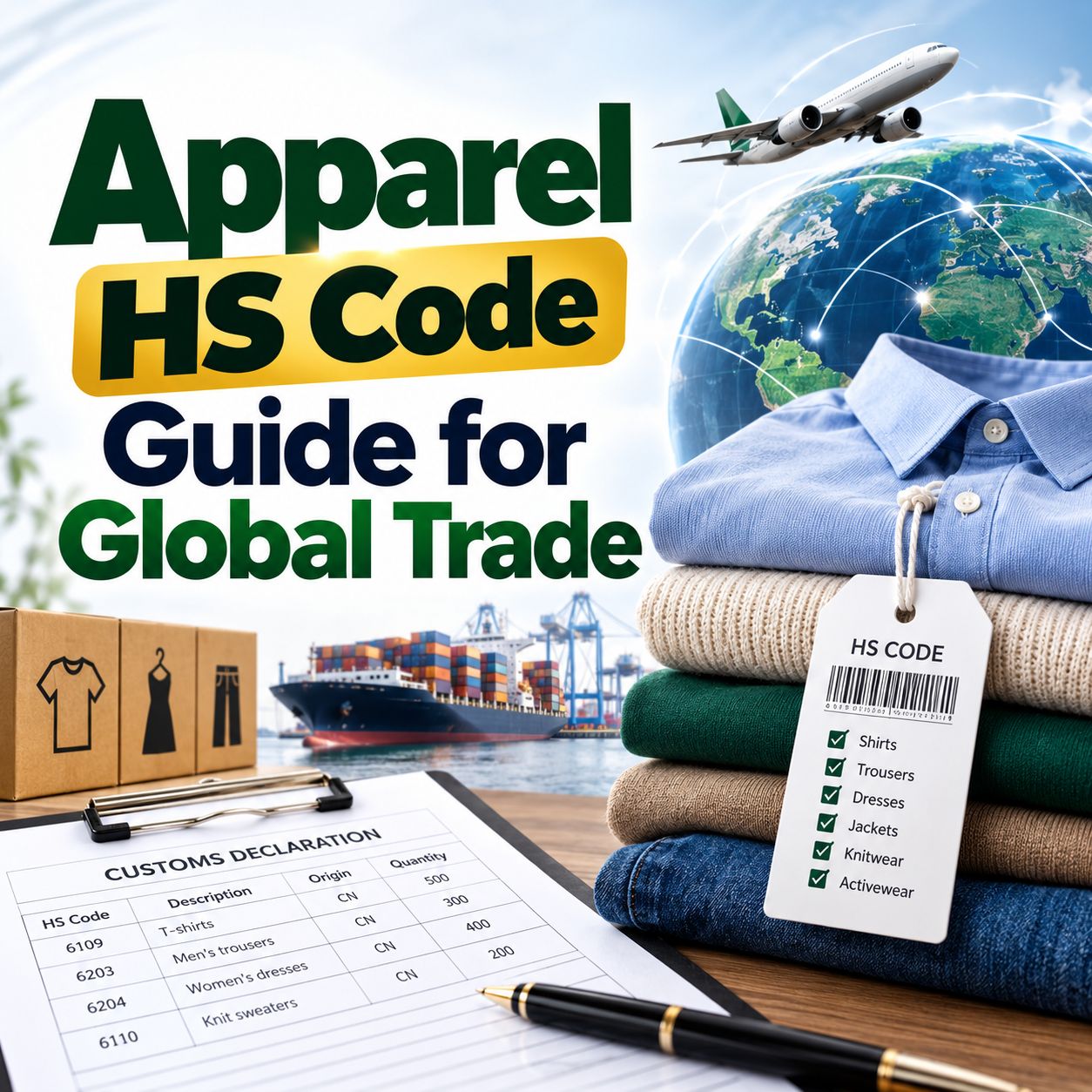
A Lagos fashion retailer has ordered cotton T-shirts from Guangzhou, while a Houston boutique is receiving polyester tracksuits from Shanghai. Both businesses need an apparel HS code before the goods are declared, but the correct answer depends on how each garment is made, where it’s going, and how the destination country extends the international tariff system.
An HS code isn’t just a product label copied from a supplier catalogue. It affects customs classification, tariff assessment, trade statistics, documentation, and sometimes import controls. Nigeria’s official Trade Portal tariff search lists garment and apparel procedures and provides fields for duty, VAT, levy, and other charges, so importers need more than a broad description such as “clothing”.
This guide gives Nigerian importers, exporters, fashion businesses, and cross-border sellers a practical decision path. You’ll learn how to separate knitted from woven garments, handle tracksuits and accessories, compare Nigeria, the USA, and China, prepare supporting documents, and verify the current national tariff line before booking cargo.
Table of Contents
- Understanding Apparel HS Code Classification
- How HS HTS and National Codes Work
- Determining the Correct Apparel Chapter
- Common Apparel Codes in Chapter 61
- Common Apparel Codes in Chapter 62
- Classifying Borderline Garments and Accessories
- Comparing Nigeria USA and China Systems
- Apparel Classification Examples for Trade
- Duty Landed Cost and Clearance Implications
- Preparing Accurate Customs Documentation
- Avoiding Common Classification Errors
- Quick Reference and Next Steps
What Is an HS Code
HS stands for Harmonized System. It is an international system used to classify traded goods.
Think of it as a common language customs authorities use to identify products crossing international borders.
Instead of relying only on descriptions such as:
“Women’s cotton shirt”
or
“Men’s knitted T-shirt,”
products are assigned numerical classifications.
The World Customs Organization’s HS Convention provides for participating customs tariff and statistical nomenclatures to follow the Harmonized System’s headings, subheadings, codes and interpretation rules, with international trade statistics available at the six-digit HS level. Countries can create further subdivisions beyond that level.
That last point is important.
The first six digits are the international HS foundation, but countries can extend the classification.
This means you shouldn’t assume that a code used for an apparel shipment into one country will necessarily be the complete tariff code required in another.
Understanding Apparel HS Code Classification
An apparel HS code is a customs classification used to identify a garment within the Harmonized System. It helps customs authorities assess the applicable tariff treatment, collect trade data, review admissibility, and check whether the declared goods match the accompanying documents. It isn’t a binding product description merely because a supplier, marketplace, or catalogue uses it.
The first question is how the garment is constructed. A T-shirt made from knitted fabric may fall under heading 6109, while a shirt made from woven fabric may fall under 6205 or another relevant provision, depending on the garment’s type and characteristics. Fibre content, gender or age group, garment form, and intended use then help determine the more specific heading or subheading.
Practical rule: Start with the physical garment, not the name used in an online listing.
The World Customs Organization’s Harmonized System supplies the shared international structure, but each importing country applies its own national tariff lines, taxes, procedures, and documentary requirements. That’s why a supplier’s code from China can be useful for investigation without automatically being valid for an import into Nigeria or the USA.
For a fashion business, classification is part of logistics planning, not an administrative afterthought. A precise description supports freight booking, customs documentation, landed-cost estimates, and communication with a broker. Businesses planning international logistics support should have the product specifications ready before the shipment is purchased.
You’ll get a more reliable result by recording the fabric construction, fibre composition, garment type, intended wearer, and country of import. That decision path is safer than searching for “clothing” and selecting the first apparently similar result.
Why Are Apparel HS Codes So Important
Your HS classification isn’t simply something your freight company types into a form.
It can influence important parts of the import process.
1. Customs Duty
Classification helps customs determine the tariff treatment applicable to the product.
2. Import Requirements
The classification can help determine whether additional requirements apply.
3. Customs Clearance
Accurate product descriptions and classification can make it easier to process a shipment correctly.
4. Landed Cost
If you don’t understand the applicable classification and import charges before purchasing, your expected profit margin may be inaccurate.
5. Compliance
Using the wrong HS code isn’t a clever way to reduce duty.
It can create compliance problems.
For Nigerian importers, Nigeria Customs notes that tariff classification and customs valuation are two core criteria in determining how much duty is payable.
How HS, HTS, and National Codes Work
The HS system works as a hierarchy. The first two digits identify the chapter, the next two identify the heading, and the final two identify the international subheading. For apparel, Chapters 61 and 62 are the primary starting points, but the shared international structure doesn’t determine every national tariff outcome.
The six-digit HS subheading is the common base used across customs administrations. Countries can then add national digits for duty treatment, statistical reporting, quotas, preferences, or other tariff distinctions. The United States extends the system through the Harmonized Tariff Schedule of the United States, commonly called HTSUS. China also uses national tariff extensions, while Nigeria applies the ECOWAS Common External Tariff with national tariff and procedural requirements.

The hierarchy in practical terms
- Chapter: The broad product family, such as knitted apparel or non-knitted apparel.
- Heading: The garment group, such as shirts, dresses, or tracksuits.
- Subheading: A narrower international description based on the product’s characteristics.
- National tariff line: The destination country’s extended code, which may contain additional digits and local distinctions.
The same broad garment description may therefore produce different duty, tax, and reporting outcomes in Lagos, Los Angeles, or Shanghai. The importer should classify the goods in the tariff system of the country where the goods will enter, rather than treating the exporting country’s code as conclusive.
This distinction also matters to businesses that sell personalised or made-to-order clothing. A practical explanation of how tariff codes affect print on demand can help sellers understand why product descriptions and destination markets matter even when each item is produced after an order.
Confirm the tariff edition, national code length, current duty fields, and applicable notes before shipment. For Nigeria, the official trade portal exposes tariff search and commodity information, but the importer still needs to match the physical product to the correct line.
Determining the Correct Apparel Chapter
Classification usually begins in Section XI, which covers textile and textile articles. The key question is whether the finished product is an apparel article or clothing accessory, and whether its fabric is knitted or crocheted.
A knitted or crocheted garment generally starts in Chapter 61. A garment that is not knitted or crocheted, including a woven garment, generally starts in Chapter 62. Fibre percentage matters later, especially for choosing a more specific tariff line, but fibre alone doesn’t decide the chapter.
A knitted cotton polo and a woven cotton shirt can look similar on a retail shelf. Customs classification treats their construction differently because knitted fabric is formed through loops, while woven fabric is formed by interlacing yarns. A made-up textile article that isn’t clothing, such as a blanket, may fall in Chapter 63. A special-purpose article, such as protective equipment with a specific legal provision, may belong outside the ordinary apparel chapters.
| Product Characteristic | Test Question | Target Chapter |
|---|---|---|
| Knitted or crocheted garment | Is the fabric formed by knitting or crocheting? | Chapter 61 |
| Woven or other non-knitted garment | Is the fabric made by interlacing yarns rather than loops? | Chapter 62 |
| Made-up textile article | Is it a textile product but not a garment or clothing accessory? | Often Chapter 63 |
| Special-purpose article | Does a specific tariff section describe its protective or technical function? | Check the relevant section outside ordinary apparel |
The process becomes more complicated when one shipment contains different product forms. A knitted tracksuit set may be considered under heading 6112, while a woven tracksuit may require heading 6211 analysis. The upper and lower pieces, presentation of the set, fabric construction, and legal tariff description all matter.
Don’t assign one code to an entire mixed container. Separate each identifiable product line and assess its construction, garment type, intended user, and relevant tariff notes.
How to Determine the Correct Apparel HS Code
Clothing classification can involve several characteristics. Before identifying an HS code, gather detailed information about the product.
Step 1: Identify the Garment
What exactly are you shipping?
A:
T-shirt
Dress
Blouse
Jacket
Trouser
Step 2: Determine Whether It Is Knitted/Crocheted or Not
This determines whether you begin in Chapter 61 or Chapter 62.
Nigeria’s tariff Chapter 61 specifically applies to made-up knitted or crocheted articles.
For example, a knitted garment shouldn’t automatically be classified using a code intended for a similar-looking woven garment.
When you’re unsure, ask your manufacturer for the fabric construction.
Don’t guess based solely on photographs.
Step 3: Identify Who the Garment Is Designed For
Some apparel headings distinguish between:
Men’s or boys’ clothing
and
Women’s or girls’ clothing.
This means product information should clearly state the intended category where the tariff classification requires that distinction.
Step 4: Identify the Main Textile Material
Next comes material composition.
Is the garment made primarily from:
Cotton
Wool
Synthetic fibres
Artificial fibres
Silk
Another textile material?
Material composition can determine the applicable subheading.
“Women’s dress” may therefore still be too vague for accurate classification.
A much better product description would be something like:
Women’s knitted cotton dress
or
Women’s woven synthetic-fibre dress.
The more accurate your product information, the easier proper classification becomes.
Common Apparel Codes in Chapter 61
Chapter 61 is the working starting point for knitted or crocheted apparel and clothing accessories. The chapter heading alone isn’t enough. You’ll normally need to identify the garment type, intended wearer, fibre composition, and any feature that changes the legal description.
For example, knitted men’s and boys’ shirts are commonly associated with heading 6105, while knitted T-shirts, singlets, and other vests are commonly associated with heading 6109. Women’s and girls’ blouses, shirts, and shirt-blouses generally fall under 6106, while dresses are addressed under 6104. Pullovers, cardigans, waistcoats, and similar knitted garments are generally found under 6110.
| HS Heading | Typical Products | Key Classification Check |
|---|---|---|
| 6104 | Knitted women’s and girls’ dresses and related garments | Confirm garment form, intended wearer, construction, and fibre |
| 6105 | Knitted men’s and boys’ shirts | Distinguish a shirt from a T-shirt or vest |
| 6106 | Knitted women’s and girls’ blouses and shirts | Check the garment’s design and intended wearer |
| 6109 | Knitted T-shirts, singlets, and other vests | Confirm the fabric is knitted or crocheted |
| 6110 | Jerseys, pullovers, cardigans, waistcoats, and similar items | Check whether the garment is a sweater-type article |
| 6112 | Knitted tracksuits, sportswear, and related garments | Review the complete set and relevant legal description |
| 6115 | Knitted hosiery and certain related clothing articles | Confirm whether the product is hosiery or another garment |
Tracksuits require special care because marketing language doesn't settle classification. A knitted sports set may be examined under heading 6112, but the construction and the way the pieces are presented still need checking. Underwear, nightwear, bathrobes, dressing gowns, and similar knitted clothing also have dedicated provisions, so a broad search for “knitted clothing” can lead you to the wrong branch.
The headings above are six-digit reference points, not guaranteed national tariff lines. Nigeria, the USA, and China may add digits or create further statistical and tariff distinctions. Before declaring an item such as 6109900000 in Nigeria, verify the current national line and charge fields. A public Nigeria lookup for that code states a default duty of 20% and notes that other taxes may apply, which shows why the exact code matters. Check the Nigeria tariff lookup entry before budgeting, and confirm the result with the official tariff system.
Common Apparel Codes in Chapter 62
Chapter 62 covers apparel that is not knitted or crocheted, including many woven garments. Begin with construction evidence, not the garment's retail name or fibre label. A polyester shirt can be woven, and a cotton shirt can be knitted, so the fibre name doesn't settle the chapter.
Woven men's and boys' suits, jackets, blazers, trousers, overalls, breeches, and shorts are generally addressed across headings 6201 through 6203, with the exact provision depending on the garment. Women's and girls' coats, suits, jackets, dresses, skirts, divided skirts, trousers, and shorts are generally covered across headings 6202 through 6204.
| HS Heading | Typical Products | Key Classification Check |
|---|---|---|
| 6201 | Woven men’s and boys’ overcoats, jackets, and similar outerwear | Confirm the outerwear form and intended wearer |
| 6202 | Woven women’s and girls’ overcoats, jackets, and similar outerwear | Check garment type, wearer, and fabric construction |
| 6203 | Woven men’s and boys’ suits, jackets, trousers, overalls, and shorts | Separate tailored garments from other apparel |
| 6204 | Woven women’s and girls’ suits, dresses, skirts, trousers, and shorts | Confirm the garment’s complete form |
| 6205 | Woven men’s and boys’ shirts | Distinguish a woven shirt from a knitted shirt |
| 6206 | Woven women’s and girls’ blouses and shirts | Review design, wearer, and construction |
| 6207 | Woven men’s and boys’ underwear and nightwear | Check whether the garment is underwear or sleepwear |
| 6208 | Woven women’s and girls’ underwear and nightwear | Confirm the intended wearer and garment function |
| 6211 | Woven tracksuits and other sportswear | Test the legal description, construction, and presentation |
A loose-fitting garment shaped like a T-shirt may still require Chapter 62 analysis if its fabric is woven. Inspect the supplier's technical information, examine the fabric surface, and ask for construction details rather than relying on the product title.
Mixed-fibre garments need a separate review. Once the chapter and garment type are established, the applicable tariff notes and national subdivisions may direct you to a fibre-based line. Record the composition accurately and make sure the invoice, packing list, labels, and supporting specifications agree.
These headings are reference points only. The destination country's extended tariff line controls the final declaration, duty assessment, and statistical reporting.
Classifying Borderline Garments and Accessories
Borderline apparel requires more than a keyword search. Customs authorities look at the finished article's construction, identity, intended use, and the legal wording of the tariff provision.
Tracksuits are a common example. Don't classify a product solely because the seller calls it sportswear. Check whether it consists of an upper and lower component, whether the components are presented together, whether the fabric is knitted or non-knitted, and whether the complete product meets the relevant tracksuit provision.
Swimwear also needs a complete-product review. Its close-fitting design and suitability for swimming can distinguish it from a general beachwear garment. Babywear shouldn't be classified merely because the commercial invoice says “baby”. The applicable nomenclature may contain age, size, or garment-specific rules, so the importer must consult the current destination tariff.
Accessories need their own analysis
- Hats and headgear: These are generally outside Chapters 61 and 62 and should be checked under the relevant headgear provisions, commonly associated with Chapter 65.
- Gloves, mittens, and mitts: These have dedicated tariff treatment and shouldn't automatically follow a jacket or other knitwear.
- Belts: A belt may fall under a specific accessory heading rather than the heading for the clothing worn with it.
- Footwear components: Uppers, outer soles, and related parts must be reviewed separately from finished footwear.
- Decorative features: Fur, leather trim, embroidery, or attached ornaments don't automatically control classification.
A feature can be essential, removable, or merely ornamental. If an accessory changes the product's essential character or performs an independent function, classify the identifiable item according to its own terms or seek professional advice where the rules overlap.
Keep product photographs, measurements, fibre details, care labels, and supplier declarations. Those records can reveal a mismatch between the commercial description and the actual garment before customs raises a query.
Comparing Nigeria USA and China Systems
Nigeria, the USA, and China use the Harmonized System as a shared international foundation, but each country can extend the code and apply its own tariff lines, taxes, statistical requirements, and customs procedures. The first six digits can provide a useful international reference, yet they don't automatically determine the importer's final declaration.
The United States uses HTSUS codes built on the HS. Nigeria uses the ECOWAS Common External Tariff framework together with national tariff and procedural systems. China uses its own national tariff extensions. The correct approach is to classify according to the system of the country where the goods will be imported, not copy the code shown on the export invoice.

A practical country comparison
| Country | Working System | What the Importer Must Confirm |
|---|---|---|
| Nigeria | CET and national tariff procedures | Current tariff line, charges, documentation, and any applicable local requirements |
| USA | HTSUS | Complete HTSUS subheading, statistical suffix, duty treatment, and applicable notes |
| China | National customs tariff | Export or import tariff line, national subdivisions, and declaration requirements |
Suppose a woman’s knitted cotton top is shipped from China into Nigeria. The broad international heading may provide a starting point, but the Nigerian importer must confirm the complete national line and current charges. The same physical garment entering the USA must be checked in the HTSUS, while a Chinese exporter may use a Chinese declaration code for the outbound shipment.
Keep a record of the tariff edition, national suffix, product specifications, and classification reasoning used for each shipment. Businesses planning shipping from China to Nigeria should complete this review before a supplier prepares the final commercial invoice.
7 Common Apparel HS Code Mistakes Importers Should Avoid
1. Copying a Competitor’s HS Code
You see another importer using a certain code and assume yours must be identical.
But their product could have a different fabric composition or construction.
Verify your own goods.
2. Using the Supplier’s Code Without Checking
Your Chinese supplier may provide an HS code.
That can be helpful, but don’t assume it is automatically the complete code appropriate for import into Nigeria or another destination.
3. Ignoring Fabric Construction
Knitted versus non-knitted is one of the biggest distinctions in apparel classification.
4. Ignoring Material Composition
Cotton and synthetic garments may have different subheadings even when the garments look almost identical.
5. Describing Everything as “Clothes”
Give customs and your logistics provider accurate product information.
6. Using One Code for Everything in a Mixed Shipment
Shoes, T-shirts, dresses, and handbags shouldn’t automatically be lumped under one apparel code.
7. Choosing a Code Because It Has a Lower Duty Rate
Your goal isn’t to find the cheapest HS code.
Your goal is to find the correct HS code.
Nigeria Customs explicitly warns that incorrect codes can lead to incorrect duty payments, penalties and delays.
Apparel Classification Examples for Trade
Classification begins with the physical product, not the marketing name. Each example below uses a different decision point so you can see how the same process applies across sourcing and export routes.
Knitted cotton T-shirts from China to Nigeria
A supplier in China sends cotton T-shirts to a Nigerian retailer. The importer should first confirm that the fabric is knitted or crocheted, then record the fibre composition, garment form, intended wearer, and product specifications. The goods should be matched to the current Nigerian tariff line only after those facts are verified.
The invoice description should identify the product as knitted cotton T-shirts rather than “clothes”. Quantity, unit value, country of origin, and any relevant product specifications should remain consistent across the shipment records.
Woven cotton shirts from Nigeria to the USA
A Nigerian fashion business exports woven cotton shirts to a US buyer. The exporter should confirm the non-knitted construction, distinguish men’s, women’s, or unisex presentation where relevant, and use the applicable US HTSUS subheading.
The buyer, broker, or importer of record should confirm the complete destination code. The Nigerian exporter’s code may help identify the six-digit family, but it isn’t proof of the US tariff line or final duty treatment.
A mixed container of fashion products
A buyer imports knitted dresses, woven trousers, hats, belts, and scarves in one container. The container shouldn’t receive one apparel HS code. Each product line needs a separate review based on:
- Construction: knitted, crocheted, woven, or another textile form.
- Product identity: garment, headgear, belt, scarf, or textile component.
- Intended use: ordinary clothing, sportswear, swimwear, or another function.
- Composition: fibre details that may determine the national subdivision.
- Destination: the tariff schedule and code length used at import.
For tracksuits, swimwear, baby garments, and garments with trim, add photographs and supplier specifications when the classification isn’t obvious. Don’t invent a duty rate or certificate requirement. Consult the official destination tariff, a customs broker, or a written ruling where the product is novel, mixed, or disputed.
Duty Landed Cost and Clearance Implications
A wrong apparel HS code can change the tariff line, duty assessment, tax calculation, statistical reporting, admissibility review, and likelihood of a customs query. The commercial impact depends on the destination country’s tariff, the customs value, exchange-rate treatment, preferences, exemptions, freight, insurance, and other applicable charges.
Nigeria’s official Trade Portal exposes duty, VAT, levy, and other charge fields for tariff searches. Its apparel categories show why “clothing” is too broad for a reliable estimate. The portal specifically groups garment procedures such as apparel, baby garments, tracksuits, swimwear, and related textile categories, so the importer should match the actual item to the appropriate procedure.

Build the cost chain
- Confirm the product description and construction.
- Confirm fibre composition and intended use.
- Find the exact destination-country tariff line.
- Determine the customs value using the applicable valuation rules.
- Add duty, taxes, freight, insurance, and other verified charges.
- Reconcile the final landed cost against the selling price and margin.
For Nigerian importers, a public tariff lookup for code 6109900000 states a default duty of 20% and notes that other taxes may apply. Treat that figure as a code-specific lookup result, not a universal apparel rate, and verify it in the current official system before issuing a final quotation.
Product fit and customer returns are separate commercial concerns. A virtual try-on guide from Robosize may help fashion sellers improve product information, but it doesn’t replace customs classification evidence.
For cargo moving from the USA into Nigeria, align the code and description before booking shipping from the USA to Nigeria. A classification error can cause delays, reassessment, amended records, or penalty exposure, especially when the invoice and physical goods don’t match.
Preparing Accurate Customs Documentation
The commercial invoice and packing list should tell the same story as the garment. A customs officer should be able to understand what the product is, how it’s made, what it contains, how many units are included, and which tariff line the importer has declared.
Avoid descriptions such as “ladies clothes”, “fashion items”, or “textiles”. They don’t identify construction or product type. A more useful description identifies the garment and its composition, such as “women’s woven polyester blouse, 65% polyester and 35% cotton”, followed by the tariff line confirmed for the destination.

Information to place on the invoice
Include, as applicable to the destination rules:
- Parties: Consignor, consignee, importer, and contact details.
- Product line: Precise garment type, intended wearer, and intended use.
- Construction: State whether the fabric is knitted, crocheted, or woven.
- Composition: Record the fibre content accurately and consistently.
- Quantity: Show unit and total quantities clearly.
- Value: State the unit value and total value in the required currency.
- Origin: Identify the country where the goods were produced.
- Tariff line: Use the destination country’s confirmed national code.
The packing list should reconcile with the invoice by product line, quantity, cartons, and packaging details. Keep supplier specifications, photographs, care labels, fibre test reports where relevant, and any permits or conformity records that the destination rules require.
Documentation practices vary between Nigeria, the USA, and China. Align every document with the importing country’s tariff and customs instructions rather than asking the exporter to copy an unverified code across all markets. Support is available through customs and export documentation services, but the importer should still review the product facts and final declaration.
Avoiding Common Classification Errors
The most common shortcut is copying the supplier’s HS code. That approach can fail because the supplier may be declaring the goods for export under a different national extension, using a broad internal product category, or relying on incomplete material information.
A men’s cotton jersey T-shirt, a polyester knitted nightshirt, and a polyester woven shirt may all be described casually as “tops”. Their construction, garment type, intended wearer, and applicable headings can differ substantially.
Watch for these mistakes:
- Fibre confusion: Cotton or polyester identifies material, not whether the fabric is knitted or woven.
- Chapter confusion: A knitted garment shouldn’t be placed in Chapter 62 because its shape resembles a woven shirt.
- Babywear assumptions: The word “baby” on an invoice doesn’t settle the tariff treatment.
- Tracksuit shortcuts: A sports label doesn’t decide whether the set or its components meet the relevant provision.
- Document mismatch: Different fibre percentages on the invoice, packing list, label, and laboratory report create avoidable questions.
- Destination copying: A Chinese export code shouldn’t be treated as automatically valid in Nigeria or the USA.
Build a short internal reference sheet for each recurring product. Record the construction, composition, garment type, wearer, destination code, supporting evidence, and date of verification. Review it whenever the supplier changes the fabric, the product design changes, or the destination market changes.
For high-value, unusual, mixed, or disputed garments, obtain written broker advice or a formal customs ruling before shipment. The cost of clarification is easier to manage than correcting a declaration after the cargo has been held or reassessed.
Quick Reference and Next Steps
Use the table as a working reference, not a final declaration. Confirm the exact six-, eight-, or ten-digit national code in the importing country’s current tariff system. A product description is like a label on a filing drawer: if it is too broad, the supporting evidence may end up in the wrong place.
| Representative Garment | HS Chapter / Heading | Key Classification Driver |
|---|---|---|
| Knitted men’s or boys’ shirt | Chapter 61, heading 6105 | Knitted construction and garment type |
| Knitted T-shirt or vest | Chapter 61, heading 6109 | Knitted construction, fibre, and national subdivision |
| Knitted women’s or girls’ blouse | Chapter 61, heading 6106 | Garment form, wearer, construction, and fibre |
| Knitted dress | Chapter 61, heading 6104 | Dress design, wearer, construction, and fibre |
| Knitted pullover or cardigan | Chapter 61, heading 6110 | Sweater-type form and fabric construction |
| Knitted tracksuit | Chapter 61, heading 6112 | Complete set, sportswear form, and construction |
| Woven men’s or boys’ shirt | Chapter 62, heading 6205 | Non-knitted construction and garment type |
| Woven women’s or girls’ blouse | Chapter 62, heading 6206 | Non-knitted construction, wearer, and garment form |
| Woven trousers | Chapter 62, headings 6203 or 6204 | Intended wearer, garment type, fibre, and construction |
| Woven tracksuit or sportswear | Chapter 62, heading 6211 | Legal description, complete product, and construction |
Before approving shipment, verify:
- Fibre composition: Does the declaration match supplier specifications and labels?
- Construction: Is the fabric knitted, crocheted, woven, or another textile form?
- Product identity: Is it a garment, accessory, textile component, or another article?
- Intended wearer: Is it men’s, women’s, unisex, or babies’ wear?
- Garment type: Is it a shirt, dress, trouser, tracksuit, swimwear item, or nightwear?
- Destination code length: Does the importing country require additional national digits?
- Documentation alignment: Do the invoice, packing list, labels, and specifications agree?
For Nigeria, consult the official Trade Portal tariff search. For the United States, use the current USITC HTS system. For China, check the relevant customs tariff publication. The WCO framework provides the international base, while the importing country’s current tariff line controls the declaration, duty exposure, and clearance documents.
For unusual, high-value, mixed, or disputed shipments, obtain written broker advice or shipment-specific classification support before the supplier finalises documents. African Import Export Solution helps businesses source, ship, document, and clear apparel and fashion products moving between Nigeria, China, the USA, and other destinations.
Why AfricanIES Is a Strong Logistics Partner for Apparel Importers
A fashion business moves quickly.
Today’s trending product can become tomorrow’s dead stock.
A delayed shipment doesn’t only create inconvenience, it can mean missed sales.
AfricanIES provides logistics solutions designed to give importers more control over their supply chain, including China warehousing, consolidation, air and ocean shipping, tracking, customs support and Nigerian delivery options.
For businesses buying from several Chinese suppliers, consolidation can be particularly useful.
Instead of every supplier arranging separate international freight, purchases can first be received in China and prepared for onward shipping.
And if you’re uncertain about how your clothing shipment should be prepared or described, providing detailed information before dispatch allows potential issues to be identified earlier.
Conclusion
Getting the HS code right may look like a small part of international apparel shipping, but a classification mistake can quickly become an expensive problem. The wrong code can affect customs duties, delay clearance, create unexpected charges, and disrupt when your clothing reaches customers or your store.
For apparel importers and exporters, the safest approach is to classify every product based on what the garment is, its material composition, how it is made, and who it is designed for rather than guessing based on the product name alone. When you are uncertain, confirm the classification before shipping.
And remember: successful global trade is not simply about getting your clothes from one country to another. It is about getting them there correctly classified, properly documented, cleared efficiently, and delivered without avoidable surprises.
With AfricanIES, businesses can simplify international shipping, documentation, customs clearance, tracking, and delivery, so you can spend less time worrying about logistics and more time growing your business.
Ready to ship apparel internationally?
Get a shipping quote from AfricanIES and start planning your next shipment with greater confidence.


Leave a Reply