

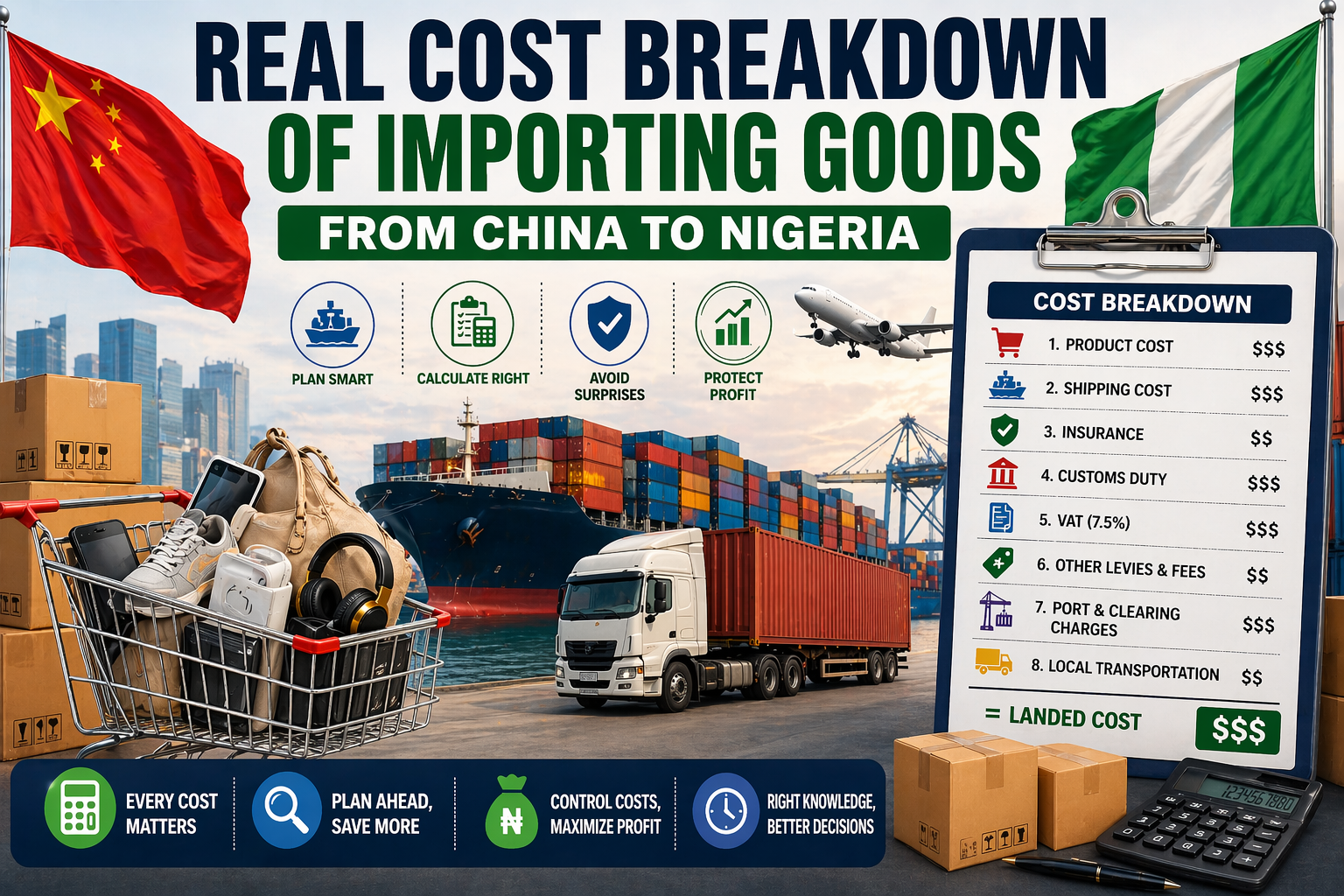

If you ask ten people what it costs to import from China to Nigeria, you’ll likely get ten different answers.
One person will mention the product price.
Another will say shipping.
Someone else will talk about customs.
And that right there is the problem.
Most importers don’t lose money because the business is bad.
They lose money because they calculate only the visible cost and ignore the real cost structure.
The supplier invoice is only the beginning.
The real number is what your goods cost when they are finally in your hands, cleared, delivered, and ready to sell.
That is what professionals call landed cost.
This guide is different from the usual blogs.
This is a profit-first cost blueprint built for Nigerian importers who want to know where every naira goes and how to keep more of it.
And most importantly, we’ll show you how AfricanIES helps simplify the movement and cost-control side of the process.
You can read this to know The Top 25 Products Nigerians Buy from the USA (And How Smart Importers Are Making Money from It)
The Real Cost Starts Before You Even Pay the Supplier
The first mistake many importers make is assuming the quoted price is the true cost.
It isn’t.
A supplier may quote you $3 per unit.
That sounds straightforward.
But the real question is:
Under what shipping term?
This is where many people get caught.
If the supplier gives you an EXW(ex works) price, you are paying from the factory door outward.
That means local movement within China, export documentation, and freight still sit on your side.
If it is FOB (Free On Board), the supplier covers delivery to the port and export handling.
If it is CIF(Cost, Insurance, and Freight), the quote includes freight and insurance to Nigeria.
This difference can significantly change your pricing structure.
So before you even start calculating margin, you need to understand what exactly the supplier quote includes.
A cheap EXW quote may end up more expensive than a higher FOB quote.
That’s one of the cost truths many people miss.
Shipping from China is the largest moving part of your total expense
This is where many import businesses either grow or quietly bleed money.
Shipping is not just a line item.
It is often the highest variable cost.
Recent freight guides for 2026 show that air freight typically ranges from $5 to $12 per kilogram, while sea freight may range from $200 to $550 per CBM(Cubic Meter) for LCL( shipments, with full containers costing significantly more depending on market conditions.
Now this is where strategic thinking comes in.
A lightweight product with a high margin may perform well with air freight.
A bulky low-margin product may need sea freight to remain profitable.
This is why cost breakdown is not just about numbers.
It is about choosing the right movement strategy.
And this is where AfricanIES becomes highly relevant.
AfricanIES helps businesses simplify the shipping side of the process so that delivery timelines, movement visibility, and cost expectations become clearer.
That clarity helps you price confidently.
Customs Duty: The Charge That Changes Everything
Now let’s talk about the cost most people underestimate.

Customs duty.
Nigeria Customs calculates import charges largely based on CIF value.
That means:
Cost + Insurance + Freight
From there, duty rates depend on the product category and HS code.
Rates may range from 0% for some items to 35% or more for others.
For example, the recent 2026 Customs duty tables show:
textiles can attract around 20%
furniture around 20%
processed food products up to 35%
Some electronics may attract 0–20%
This means your product category determines your real cost significantly.
A small classification mistake can change your margin.
That is why HS code verification is not something to guess.
VAT and Government Charges Add Another Layer
After customs duty comes VAT.
As of 2026, the standard VAT rate remains 7.5% in Nigeria.
This is usually calculated on the value of goods plus duty and other assessable charges.
Then depending on the product, there may be:
CISS(Comprehensive Import Supervision Scheme)
ETLS levy (ECOWAS Trade Liberalisation Scheme)
Additional import levy
Regulatory fees
Terminal charges
These charges often look small individually.
But when added together, they materially change your landed unit price.
That’s why smart importers always calculate per-unit landed cost rather than total shipment spend.
Port and Clearing Charges Are Often Underestimated
This is where many first-time importers are surprised.
The goods have arrived.
You think you’re almost done.
Then port and clearing fees begin to stack up.
Recent cost guides estimate port and clearing charges from ₦150,000 to over ₦1,500,000, depending on shipment type and volume.
These may include: Terminal handling, documentation release, customs processing, inspection, shipping line charges, delivery order fees & agent fees.
This is where delays become expensive.
Every extra day can add storage and demurrage.
That means time itself becomes a cost factor.
This is why logistics planning matters so much.
The Hidden Cost Most Importers Never Price: Delay

Here’s where this article becomes completely different.
The most dangerous cost is not always the visible one. It is delayed.
A delayed shipment affects more than delivery.
- It affects cash flow.
- Inventory turnover.
- Customer promises.
- Reorder timing.Sales campaigns.
A shipment delayed by two weeks may cost you more in lost opportunity than the actual freight bill.
That is why the real cost breakdown must include time cost.
This is something many businesses fail to include.
And yet it directly affects profit.
Why AfricanIES Matters in the Cost Equation
The movement side of importation is where most cost surprises happen.
This is where AfricanIES fits strategically.
AfricanIES helps businesses simplify the logistics process into Nigeria by reducing uncertainty around movement, timing, and delivery coordination.
This helps you forecast better.
And better forecasts protect margin.
Because the real cost breakdown of bringing goods into Nigeria from China is not just a financial calculation. It is a logistics calculation too.
You can also read: What Nobody Tells You About Importing from China
Explore: Ocean Shipping from the USA to Nigeria
Final Thoughts
The true pricing structure of bringing goods into Nigeria is never just about what the supplier charges.
It is the full journey.
Supplier quote.
Freight.
Duty.
VAT.
Clearing.
Local movement.
Time.
Delay risk.Cash flow impact.
When these numbers are understood properly, importation becomes a profitable business model.
When they are guessed, it becomes expensive.
That is why combining accurate landed cost calculation with reliable logistics support through AfricanIES gives Nigerian businesses a stronger path to predictable profit.
Awarded Most Reliable Shipping Company (2019-2023)

FAQs
What is the real cost of importing goods from China to Nigeria?
The real cost of importing goods from China to Nigeria includes more than just the supplier’s invoice. It covers product cost, shipping charges, customs duty, VAT, CISS, ETLS levy, port clearing fees, and final delivery to your warehouse or doorstep in Nigeria. To calculate true profit, always focus on the landed cost per unit.
What does CIF mean in importation?
CIF means Cost, Insurance, and Freight. This means the supplier covers the product cost, shipping freight, and basic insurance up to the destination port, such as Lagos port. However, you are still responsible for customs clearance, VAT, and local delivery within Nigeria.
What is the difference between FOB and EXW?
EXW means Ex Works, where the seller only makes the goods available at their factory or warehouse, and the buyer handles all shipping and export arrangements.
FOB means Free On Board, where the supplier handles delivery to the port and loading onto the vessel, while the buyer takes responsibility from that point onward.
How much is customs duty for imports in Nigeria?
Customs duty in Nigeria depends on the product type and HS code. Rates can range from 5% to 35% or more, depending on whether you are importing electronics, fashion items, food products, or machinery. The duty is usually calculated based on the CIF value of the goods.
What is CISS in Nigeria importation?
CISS stands for Comprehensive Import Supervision Scheme. It is an administrative levy traditionally charged at 1% of the FOB value of imported goods, although import charges may change based on current customs regulations.
What is ETLS in importation?
ETLS means ECOWAS Trade Liberalisation Scheme. It is a regional trade framework that supports trade within West Africa. In some cases, an ETLS levy may apply to goods entering the region from outside ECOWAS.
How does AfricanIES help with importing goods to Nigeria?
AfricanIES helps simplify international shipping and delivery into Nigeria by providing a more structured logistics process, clearer shipment visibility, and reliable support for delivery coordination, helping businesses manage costs and timelines more effectively.
Next Step
Ready to start an importation business ?


Leave a Reply