

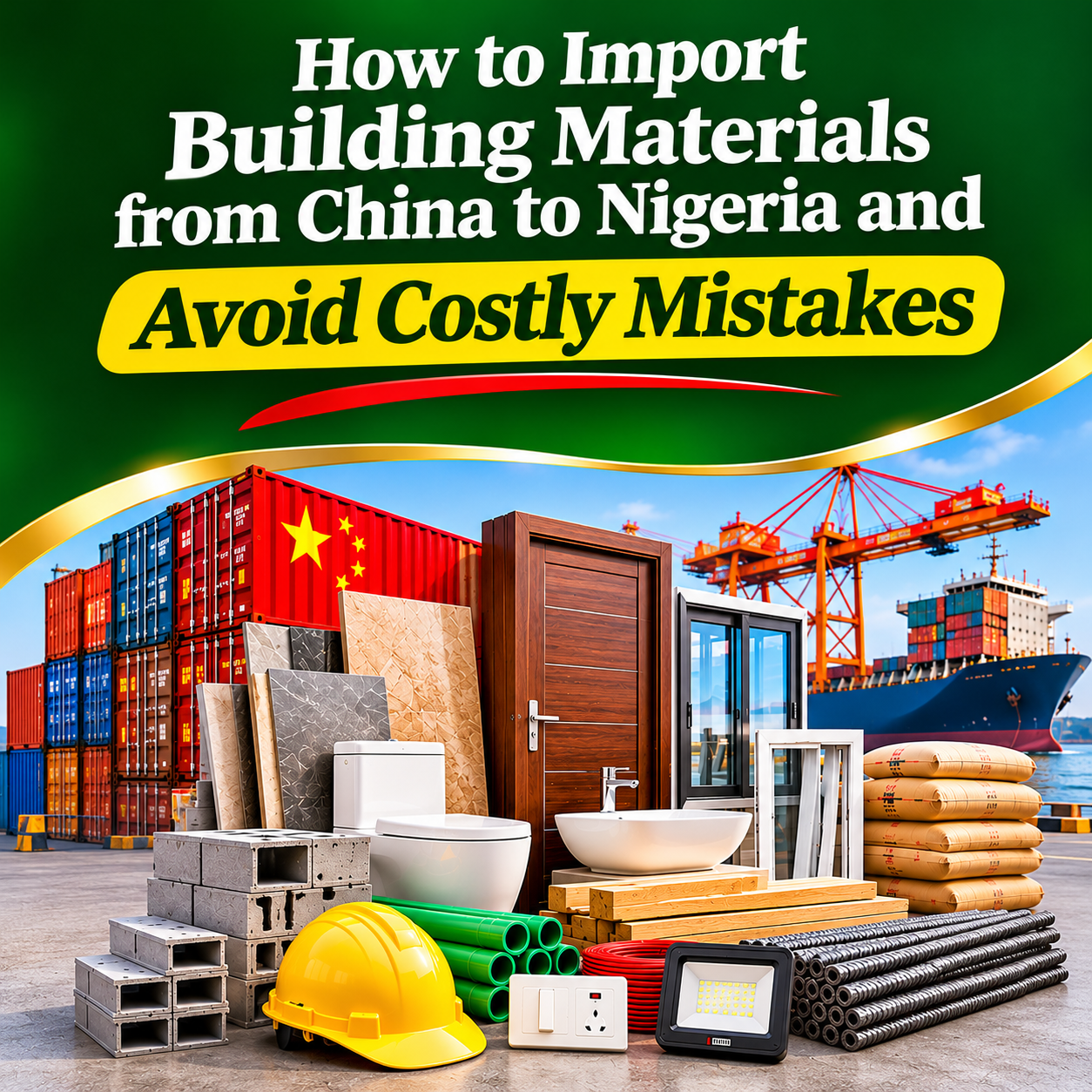

What if you could complete your next construction project with quality building materials while spending significantly less on procurement?
For contractors, property developers, building material dealers and construction companies in Nigeria, rising material costs remain a major challenge. From doors and windows to tiles, sanitary fittings, electrical supplies and lighting, the cost of purchasing locally can consume a substantial portion of a project’s budget.
But what if you could purchase directly from the manufacturers supplying these products?
China offers contractors and developers an opportunity to access competitive factory prices, customised building materials and a wider selection of products without depending entirely on local distributors.
However, importing building materials requires more than finding a cheap supplier. You need to understand product quality, supplier verification, international payments, shipping, customs clearance and the actual landed cost of your materials.
In this guide, we will explain how to import building materials from China to Nigeria, reduce procurement expenses and get better value for your construction budget with AfricanIES.
Table of Contents
-
- Why contractors and developers should import building materials from China
- Best building materials to import from China to Nigeria
- Where to buy building materials in China
- Step-by-step guide to importing building materials from China
- How much can you save by importing directly from China?
- How to reduce the cost of shipping building materials
- How to pay Chinese building material suppliers in Naira
- Import requirements and customs clearance in Nigeria
- Costly mistakes contractors and developers should avoid
- How AfricanIES helps construction businesses import from China
- Start importing building materials from China today
- Frequently asked questions
Why Contractors and Developers Should Import Building Materials from China
The profitability of a construction project is heavily influenced by how effectively procurement costs are managed.
When you purchase building materials through several intermediaries, you may be paying for multiple layers of transportation, distribution and profit margins.
Importing directly from China gives you greater control over your purchasing decisions.
Reduce construction and procurement costs
Chinese manufacturers often offer competitive prices, particularly for commercial and bulk orders.
By comparing manufacturers and negotiating directly with suppliers, contractors can potentially reduce material expenses without compromising agreed quality standards.
For developers handling multiple housing units, hotels, estates or commercial buildings, even a modest reduction in the cost per unit can translate into substantial project savings.
Access modern and premium building materials
China manufactures a wide variety of construction and finishing materials, including contemporary designs that may be expensive or difficult to find locally.
Developers can access premium doors, modern lighting systems, luxury bathroom fittings, decorative wall panels and customised interior finishes.
This allows you to deliver attractive properties while maintaining better control over your budget.
Customise materials to suit your project
Instead of adjusting your building designs to accommodate locally available materials, you can explore manufacturers that produce according to your specifications.
Depending on the supplier, you may be able to customise dimensions, colours, materials, finishes, packaging and branding.
Improve your competitive advantage
For contractors bidding for construction projects, reducing procurement costs could help you submit more competitive quotations while protecting your profit margins.
For property developers, better purchasing decisions could free up capital for additional housing units, infrastructure and other project requirements.
Reduce dependence on local suppliers
Direct importation gives your construction business an additional procurement channel.
Rather than relying entirely on local market availability and pricing, you can establish relationships with overseas manufacturers and plan purchases around your project requirements.
Ocean tracking identifiers and where to find them
Best Building Materials to Import from China to Nigeria
Not every construction material is economical to import. The best products are those that offer a favourable balance between purchase price, quality, shipping expenses and local market value.
| Product category | Products to consider |
|---|---|
| Doors and windows | Security doors, aluminium windows, sliding doors, glass doors |
| Tiles and flooring | Ceramic tiles, porcelain tiles, vinyl flooring, SPC flooring |
| Bathroom and sanitary fittings | Toilets, washbasins, bathtubs, shower systems, taps |
| Plumbing materials | Pipes, valves, connectors, pumps and fittings |
| Electrical supplies | Switches, sockets, distribution boards and circuit breakers |
| Lighting equipment | Chandeliers, LED lights, outdoor lights and streetlights |
| Roofing and decorative panels | Roofing accessories, wall panels and ceiling panels |
| Hardware and tools | Locks, hinges, fasteners and construction tools |
| Interior fittings | Kitchen cabinets, wardrobes and decorative fittings |
| Security equipment | CCTV cameras, smart locks and access control systems |
| Construction machinery | Concrete mixers, compactors and selected production equipment |
| Solar and backup power | Solar panels, inverters and energy storage systems |

Before purchasing, confirm the applicable Nigerian import restrictions, product standards and certification requirements.
For low-value, extremely heavy materials such as sand, aggregates and certain cement products, purchasing locally may be more economical than importing.
The objective is not to import everything from China. It is to import what gives your project better value.
How Much Can You Save by Importing Building Materials Directly from China?
Consider a property developer purchasing doors, bathroom fittings, lighting and interior finishing materials for a residential estate.
The following example demonstrates how direct procurement could affect the project’s budget.
| Building materials | Local purchase | China landed cost | Potential savings |
|---|---|---|---|
| Doors and windows | ₦12,000,000 | ₦8,500,000 | ₦3,500,000 |
| Bathroom fittings | ₦8,000,000 | ₦5,500,000 | ₦2,500,000 |
| Lighting equipment | ₦5,000,000 | ₦3,200,000 | ₦1,800,000 |
| Interior fittings | ₦10,000,000 | ₦7,000,000 | ₦3,000,000 |
| Electrical accessories | ₦5,000,000 | ₦3,800,000 | ₦1,200,000 |
| Total | ₦40,000,000 | ₦28,000,000 | ₦12,000,000 |
Illustrative construction procurement comparison
₦12,000,000
Potential savings of 30%
Local procurement ₦40M
Direct China procurement ₦28M
Hypothetical example for equivalent products. These are not actual supplier quotations or guaranteed savings.
Imagine what an additional ₦12 million could do for a construction project.
It could fund additional finishing work, improve infrastructure, cover labour expenses or increase the developer’s overall profitability.
Actual savings will depend on supplier quotations, product quality, order quantities, exchange rates, freight and customs charges.
The money you save on procurement is money you can reinvest in your project.
Ocean shipment milestones for Nigerian imports
How to Reduce the Cost of Shipping Building Materials from China to Nigeria
Shipping is one of the most important factors when importing construction materials.
A competitive factory price can quickly lose its advantage if the wrong shipping method is selected.
Choose ocean shipping for bulk materials
Ocean shipping is generally more economical for heavy and bulky construction products such as tiles, doors, furniture, sanitary ware and machinery.
| Shipping method | Estimated delivery | Suitable for |
|---|---|---|
| Air Express | 3–5 business days | Samples and urgent accessories |
| Air Cargo | 5–10 business days | Lightweight materials and urgent components |
| Ocean Shipping | 40–45 days | Bulk construction materials |
These are indicative AfricanIES service timelines, subject to cargo requirements and shipping schedules.
Understand CBM shipping
CBM stands for cubic metre. It measures the volume occupied by your shipment.
For example, a packaged shipment measuring 2 metres long, 1.5 metres wide and 1 metre high occupies:
2 × 1.5 × 1 = 3 CBM
Building Materials CBM Calculator
Calculate the estimated volume of your packaged building materials.
Length (metres)
[Input value unavailable]
Width (metres)
[Input value unavailable]
Height (metres)
[Input value unavailable]
Number of packages
[Input value unavailable]
Total shipment volume
CBM
Use external packaging dimensions. Weight limits and special handling charges may also affect your shipping quotation.
You don’t need to fill an entire container
Many contractors assume they must purchase enough building materials to fill a 20ft or 40ft container before importing from China.
That is not necessarily the case.
With AfricanIES ocean consolidation services, you can ship smaller commercial volumes without booking an entire container.
This makes direct importation more accessible to contractors handling smaller residential and commercial projects.
Consolidate orders from multiple manufacturers
Rather than shipping each product category separately, arrange for suppliers to deliver to one warehouse in China.
Consolidation can reduce duplicated handling expenses and simplify shipment coordination.
Plan your purchases early
Do not wait until your construction site runs out of materials before arranging importation.
Emergency air shipping for heavy construction products can significantly increase costs.
Align your procurement schedule with your construction milestones, allowing sufficient time for manufacturing, shipping and clearance.

How to Pay Chinese Building Material Suppliers in Naira
You have found a manufacturer offering the exact doors, tiles or bathroom fittings your project requires at an attractive price.
But the supplier only accepts payment in RMB.
For many Nigerian contractors, international payment challenges and language barriers make direct procurement unnecessarily complicated.
AfricanIES helps remove these obstacles through our China procurement service.
Simply send us your supplier details, product specifications or procurement list. Our team can communicate directly with the manufacturer, confirm purchasing requirements and coordinate payment.
You pay in Naira. We handle the RMB payment and purchasing arrangements in China.
Whether you are purchasing from Alibaba, 1688 or directly from a Chinese factory, our team can assist you throughout the procurement process.
Import Requirements and Customs Clearance in Nigeria
Before importing building materials into Nigeria, it is important to understand the applicable regulations.
Different construction products may attract different customs duties, levies, certification requirements and import restrictions.
Standards Organisation of Nigeria (SON)
Certain building materials, electrical products and industrial equipment may fall under the Standards Organisation of Nigeria Conformity Assessment Programme (SONCAP).
Where applicable, the necessary conformity certificates should be arranged before shipment.
This is particularly important for products that could affect structural integrity, electrical safety, fire protection or public health.
Import documentation
Depending on the products and applicable import procedures, you may require a commercial invoice, packing list, Bill of Lading, Form M, PAAR, insurance documentation, certificate of origin and relevant conformity certificates.
Customs duties and taxes
Customs charges depend on the product’s HS code, customs valuation and applicable tariff classification.
There is no single customs duty rate that applies to all building materials.
Before paying your supplier, obtain a product-specific assessment of the applicable import charges and confirm that the materials are eligible for importation.
AfricanIES can assist with reviewing your shipping and customs clearance requirements.
Costly Mistakes Contractors and Developers Should Avoid
Choosing price over quality
Cheap electrical fittings, inadequate plumbing materials, and substandard doors can result in expensive replacements, safety concerns, and dissatisfied clients.
Always purchase according to approved project specifications.
Paying an unverified manufacturer
A supplier’s online profile does not guarantee that the company is legitimate or capable of fulfilling a large construction order.
Verify before you pay.
Ordering incorrect dimensions
Custom-made doors, windows, cabinets and sanitary fittings may be difficult to return or replace.
Confirm all measurements with your project team before approving production.
Ignoring packaging requirements
Tiles, glass, mirrors and sanitary fittings require appropriate protective packaging.
Confirm how fragile products will be packed, handled and insured before shipment.
Failing to order sufficient replacement materials
For products such as tiles and decorative panels, replacement batches may differ in colour, pattern or finish.
Discuss appropriate spare quantities with your technical team before placing your order.
Underestimating delivery timelines
Production delays, vessel schedules and customs procedures can affect construction timelines.
Build reasonable contingency time into your procurement schedule.
Ignoring the landed cost
A product that costs less in China may not necessarily cost less after shipping and clearance.
Compare the complete landed cost against equivalent locally available products before purchasing.
How AfricanIES Helps Contractors and Developers Import Building Materials from China
You should not have to manage multiple overseas suppliers, negotiate in an unfamiliar language, struggle with RMB payments, and coordinate international logistics while supervising a construction project.
At AfricanIES, we provide end-to-end procurement and shipping support for Nigerian businesses buying from China.
With our operational team and warehouse in Foshan, Guangdong Province, we can assist you throughout the purchasing and importation process.
| Our service | How it benefits your construction project |
|---|---|
| Product sourcing | Find suitable manufacturers for your building materials |
| Supplier verification | Reduce the risk of dealing with unreliable suppliers |
| Price negotiation | Explore better prices and purchasing terms |
| Sample verification | Review product samples before bulk purchases |
| Company visits | Obtain additional information about supplier operations |
| Procurement service | Coordinate purchases directly with suppliers |
| RMB payment service | Arrange payment in Naira without needing a Chinese bank account |
| Pre-shipment verification | Check agreed product details before shipping |
| Warehouse consolidation | Combine orders from multiple suppliers |
| Ocean and air shipping | Select shipping options suited to your project |
| Shipment insurance | Protect against covered shipping risks, subject to policy terms |
| Customs clearance | Coordinate applicable import clearance procedures |
| Local delivery | Arrange transportation to your preferred destination |
Already have a supplier in China?
Send us your supplier details and building material requirements.
Our procurement team can assist with supplier communication, verification, purchasing, payment and shipping arrangements.
Still looking for building material manufacturers?
Our sourcing service starts from $25, with quotations from up to three suitable suppliers.
Simply provide your product pictures, specifications, quantities or Bill of Quantities, and our team can help you explore available purchasing options.
Who can benefit from our services?
AfricanIES supports property developers, building contractors, construction companies, architects, interior designers, real estate investors, building material wholesalers, hotel developers, and individuals building their own homes.
Whether you are constructing a single residential property or developing an entire estate, we can help you explore a more efficient way to procure building materials from China.
Conclusion
Your Next Construction Project Could Cost Less Than You Think
You do not always need to increase your construction budget to deliver a better project.
Sometimes, you simply need to change where and how you purchase your materials.
Instead of paying multiple layers of distributor mark-ups, explore what manufacturers in China can offer. Compare prices, negotiate better purchasing terms and make informed procurement decisions.
With AfricanIES, you have a team on the ground in China working to simplify the process, from finding suitable manufacturers to purchasing, shipping and customs clearance.
Don’t commit your next construction budget without exploring what you could save by buying directly from China.
Already have a supplier? Let us handle your procurement.
Looking for better prices? Let our team find suitable manufacturers for you.
Have a Bill of Quantities? Share it with us to discuss your purchasing requirements.
Buy Better. Pay Less. Build More.
Call 07008007000 or visit http://www.africanies.com to get started.


Leave a Reply