

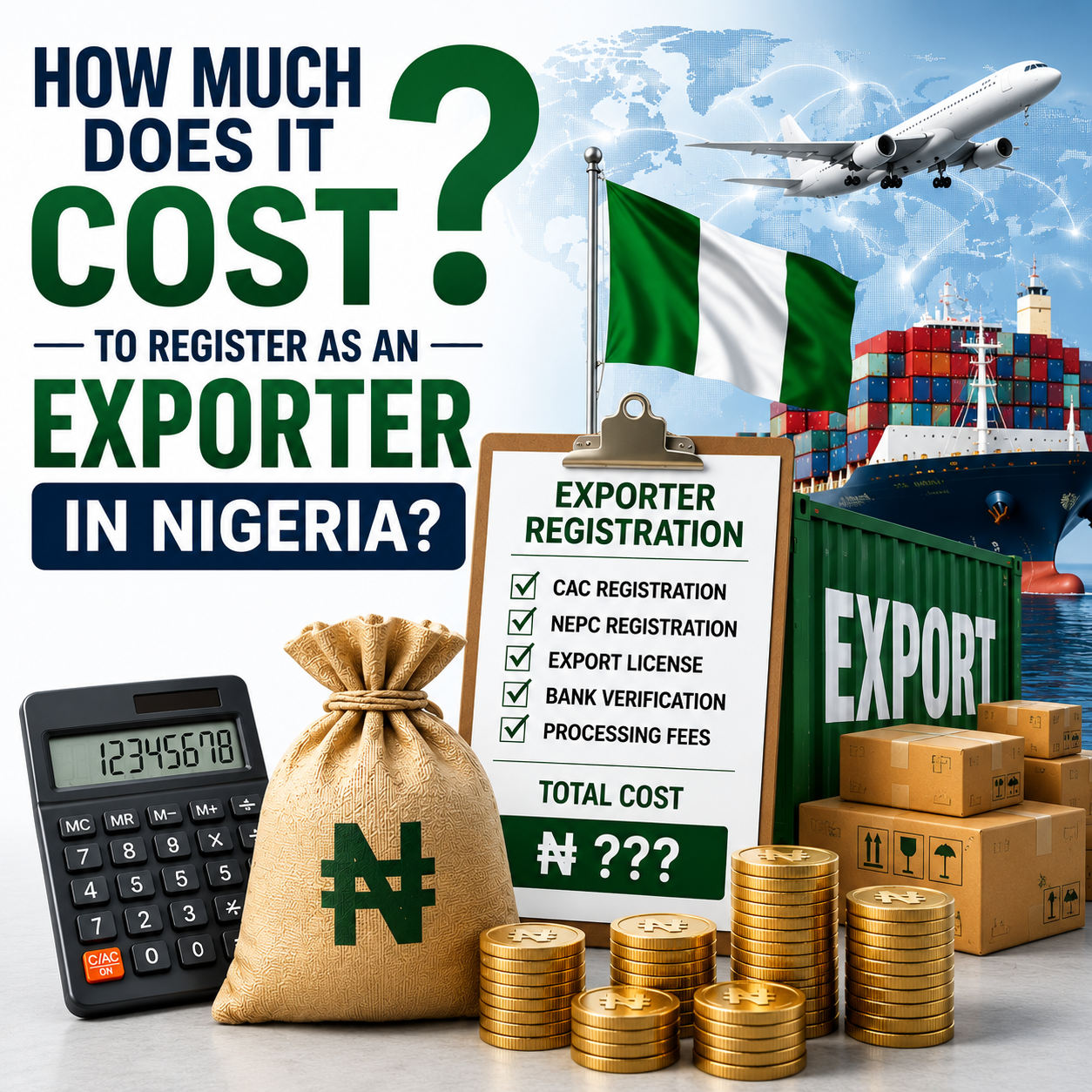

Everybody talks about exporting like it’s a secret door to wealth.
“Export and earn in dollars.”
“Export agricultural products and become financially free.”
“Export is the future.”
They’re not wrong.
Right now, thousands of Nigerians are making serious money by exporting products made in Nigeria to buyers in the USA, UK, Canada, UAE, China, and other international markets. But before most people take the first step, they usually ask one important question:
“How Much Does It Cost to register as an exporter in Nigeria?”
It’s a fair question. After all, understanding the cost of getting started is one of the first things any serious entrepreneur wants to know before investing time and money into a new business opportunity.
Unfortunately, there’s a lot of misinformation online. Some people believe the cost of becoming a registered exporter runs into millions of naira. Others assume export registration is completely free. Then there are those throwing random figures around without explaining what the actual process involves.
The truth lies somewhere in the middle.
When you take a closer look at How Much Does It Cost to become an exporter in Nigeria, you’ll discover that the registration process is often more affordable than many people expect. However, there are several stages involved, and the total cost depends on the type of export business you plan to operate, the products you intend to export, and the level of support you need.
There’s also something many beginners don’t realize. The registration fee is only one part of the journey. While researching How Much Does It Cost to register as an exporter in Nigeria is important, there are additional expenses that can affect your budget if you’re not prepared. These may include business registration, export licensing, product certifications, packaging, logistics, compliance requirements, and market-entry costs.
Understanding the full cost of becoming an exporter helps you avoid surprises, plan properly, and build a stronger foundation for your export business.
If you’ve been considering exporting from Nigeria, this guide will break down How Much Does It Cost to register as an exporter, explain the key expenses involved, and help you avoid costly mistakes that can slow down your journey into international trade.
Do You Want To Know What the Tax Implications of Exporting from Nigeria are? Read this
The Basic Costs of How Much Does It Cost to Register as an Exporter in Nigeria
Let’s break the major costs down properly so you know exactly what you’re paying for, and why.
CAC Business Registration
Before you can export legally, you need a registered business. The Corporate Affairs Commission handles this, and it’s the foundation everything else sits on. You can’t get an NEPC certificate or open a domiciliary account for export payments without it.
The cost depends on whether you register a business name or a limited liability company. Many small exporters start with a business name because it’s cheaper and simpler. It gets you a legal identity fast and keeps your initial costs low.
Larger international buyers, though, often prefer dealing with registered limited companies because they look more structured and trustworthy on paper. If you use an agent, registering a business name usually falls in the lower range, while registering a limited liability company can be higher. Doing it yourself on the CAC portal cuts down those costs, but most people pay for help to avoid mistakes. The cost can vary depending on:
- Registration type
- Filing fees
- Professional service charges
- Documentation support
For many small businesses, this is the first real investment in the export business. A registered business gives your operation credibility. When you send an invoice or sign a contract, international buyers check it. They’re far more likely to trust a properly registered company than someone operating informally on Instagram or WhatsApp.
Nigerian Export Promotion Council (NEPC) Registration
This is the registration most people mean when they say “becoming an exporter in Nigeria.” The Nigerian Export Promotion Council is the government agency responsible for promoting non-oil exports, and you need their certificate to export legally and access incentives.
The official fee for a new NEPC Exporter’s Certificate typically ranges from ₦10,000 to ₦15,000, making it affordable compared to the opportunities in exporting. The certificate is valid for a couple of years, and renewal costs less than the initial registration if you renew on time. To register, you’ll need your CAC certificate, TIN, company details, and product information ready.
One mistake many beginners make is assuming NEPC registration automatically makes them export-ready. It gives you legal recognition as an exporter and opens doors to training, market linkages, and incentives. However, you still need product certifications, proper shipping documents, and a Nigeria Export Proceeds (NXP) form from your bank before your goods can leave the port.
Tax Identification Number (TIN)
Your business also needs a Tax Identification Number before you can move smoothly in export. It’s issued by the Federal Inland Revenue Service (FIRS), and while it sounds like a tax thing, it’s really a compliance key that unlocks a lot of the export process. Export transactions often involve banking documentation, customs processing, international payments, and government compliance.
- Banks won’t process your NXP form without it.
- Customs won’t clear your goods without it.
- And foreign buyers usually ask for it when they’re doing due diligence on who they’re paying.
In many cases, the TIN comes alongside your business registration process. When you register with CAC, your details are forwarded to FIRS, and you can get your TIN without extra hassle. Without proper tax registration, some export processes can become difficult later, as you might find your payment stuck at the bank, or your shipment held at the port because a document is missing.
Bank Account Setup for Export Transactions
This is another area where beginners often overlook, and it can cause real delays when money starts moving. Export business is different from regular local business because you’re dealing with foreign currency and international compliance rules.
You’ll often need a corporate bank account that’s set up for export operations. That means having export documentation support from your bank, access to international payment channels like SWIFT, and the ability to handle foreign exchange compliance. Regular business accounts sometimes can’t receive dollar payments or process NXP forms, so you’ll need to tell your bank upfront that you plan to export.
Some banks may require additional documentation for export operations beyond your CAC certificate and TIN. They want to be sure your business is legitimate before they open you up to international transactions.
Product Certification Costs
This is where costs can begin to vary, and it depends entirely on what you’re selling. Some products are easy to export with just your NEPC certificate, whereas others require extra approvals before any buyer or customs officer will touch them.
If you’re exporting packaged food products, cosmetics, beverages, or processed agricultural goods, you’ll likely need certifications from agencies like NAFDAC, SON, or the Nigerian Agricultural Quarantine Service. These agencies check that your product meets health, safety, and quality standards for export markets. Raw agricultural produce usually goes through the quarantine service, while processed goods and cosmetics fall under NAFDAC.
And these certifications can increase your start-up costs significantly compared to the basic registrations. The process also takes more time because it involves lab tests, inspections, and documentation reviews. This is one reason why beginners should first understand their product category before jumping into the export business.
The Hidden Costs Most New Exporters Never Expect
Now this is where things get interesting, because the real surprise isn’t usually the registration fee, it’s the hidden operational costs nobody talks about enough, and they’re what break most first-time exporters.
- Product Packaging
International buyers care deeply about packaging, often more than the product itself at first glance. A product that sells well in a Nigerian market may completely fail internationally due to poor packaging that doesn’t meet buyer expectations or shipping requirements. Export-standard packaging may include proper labelling, consistent branding, food-grade materials, vacuum sealing for shelf life, strong export cartons, and compliance labelling for the destination country.
Each of those elements adds to your cost and planning time. Good packaging is not just decoration; it affects trust, pricing, and market acceptance. A buyer comparing your product to one from Ghana or Kenya will judge you partly on how professional it looks on the shelf. If it looks like it was packed for a local market, they’ll assume the quality inside is the same.
- Logistics and Shipping
Shipping is one of the biggest export expenses, and it’s unpredictable if you don’t plan. Your costs may depend on:
- Product size
- Product weight
- Destination country
- Shipping method
- Customs handling
- Storage
Air freight is faster but more expensive, while sea freight is cheaper but slower and more complex with documentation. Either way, you’ll deal with freight forwarders, port charges, or handling fees that vary by shipment. This is why many beginners struggle after registration. They register successfully but underestimate logistics costs and realize too late that shipping can eat up most of their profit.
- Documentation and Customs Processing
Export documentation can quickly become stressful and expensive when handled incorrectly. Mistakes can lead to shipment delays, financial penalties, rejected goods, and buyer complaints that can damage your reputation. Customs and port authorities are strict because every document ties back to foreign exchange tracking and government records.
This is why experienced exporters usually work with professionals who understand customs procedures properly. A good clearing agent knows what documents to prepare and how to avoid hold-ups. It costs more upfront, but it saves you money and stress compared to fixing errors mid-shipment.
- Product Sourcing
If you’re exporting agricultural products, sourcing quality products consistently is a major factor that most people don’t prepare enough for. Many international buyers reject shipments because products don’t meet the standards agreed in the contract. Issues like high moisture levels, contamination, poor sorting, and inconsistent quality can damage business relationships quickly. One bad shipment can get you blacklisted by a buyer who was ready to place repeat orders.
What’s the Realistic Cost of Becoming Export-Ready?
Here’s the honest answer: there is no single fixed amount. Why? Because export businesses are different. Someone exporting raw cocoa beans will not spend the same amount as someone exporting packaged skincare products. Someone shipping small samples abroad won’t spend the same amount as a company exporting full containers internationally.
But generally speaking, your start-up cost depends on your product type, business structure, certifications needed, packaging quality, logistics plan, and export scale. Each of those choices shifts the investment up or down. Raw produce with minimal processing will always be lighter on upfront costs than processed goods that need lab testing and regulatory approval.
The smartest approach is not asking “what is the cheapest way to register?” Instead, ask “how do I build a sustainable export business properly?” Because, in international trade, poor preparation can become expensive very fast. A rejected shipment, a delayed payment, or a buyer who loses trust costs more than getting the foundations right from the start.
Awarded Most Reliable Shipping Company (2019-2023)

FAQs
Do I need a registered business before becoming an exporter?
Yes. Before you can legally export from Nigeria, you need a registered business through the Corporate Affairs Commission (CAC). Most exporters operate as either a Business Name or a Limited Liability Company.
What documents do I need to register as an exporter?
Common requirements include:
- CAC registration documents
- Tax Identification Number (TIN)
- Valid means of identification
- Company bank account
- NEPC registration documents
- Business address information
Additional requirements may apply depending on your products and export destination.
What is NEPC registration?
NEPC registration is the process of registering with the Nigerian Export Promotion Council (NEPC). It officially recognizes your business as an exporter and is one of the key requirements for conducting export transactions legally.
Is NEPC registration compulsory?
Yes. If you intend to export goods commercially from Nigeria, NEPC registration is generally required to access export documentation, process transactions, and participate in export-related programs.
Is export registration a one-time process?
Some registrations and licenses may require renewal or periodic updates. Exporters should stay informed about current regulatory requirements and renewal obligations.
How long does it take to register as an exporter in Nigeria?
The timeline depends on how quickly you complete the required documentation and approvals. Delays usually occur when documents are incomplete or submitted incorrectly.
How can AfricanIES help with exporter registration?
African Import Export Solutions (AfricanIES) helps businesses through:
- Export registration guidance
- NEPC registration support
- Export training and mentorship
- Documentation assistance
- Logistics and shipping solutions
- Export readiness support
- International trade guidance
We help businesses move from the idea stage to becoming active exporters in global markets.
Next Step
Ready to start an export business?


Leave a Reply